

The Confession on the Consent Calendar: Tuesday, August 25th, 2026 Shasta County Agenda
 By Benjamin Nowain•August 25, 2026•10 min read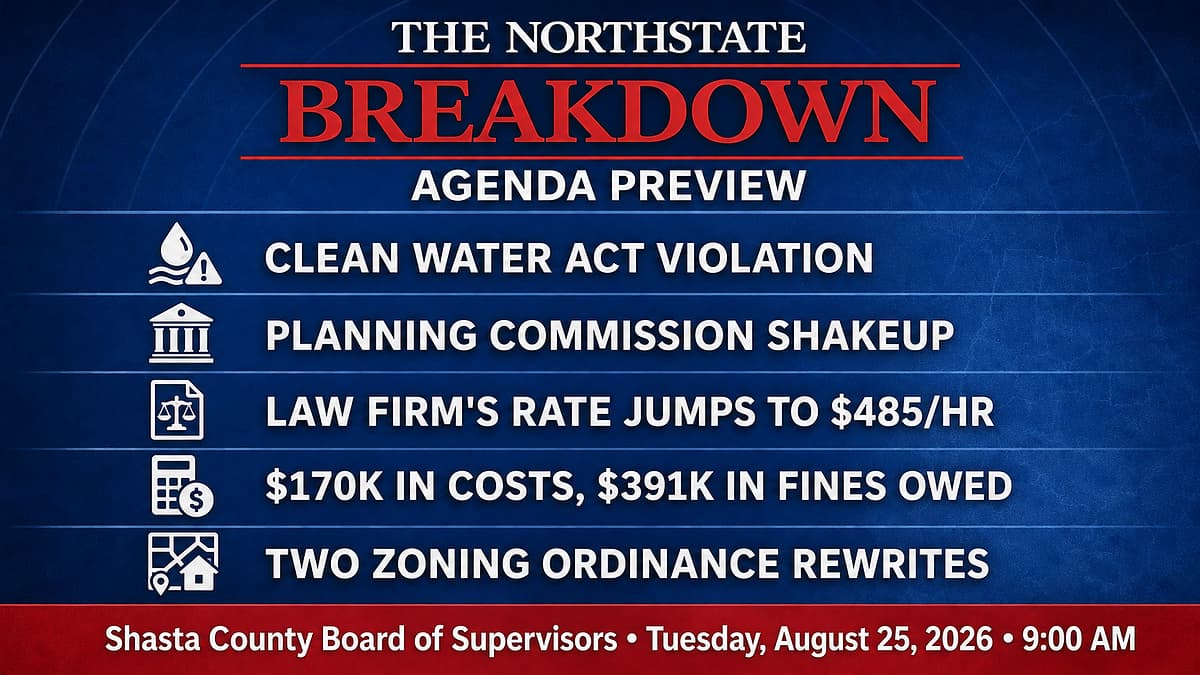
The Shasta County Board of Supervisors meets Tuesday, August 25, with an agenda that runs long on paperwork and short on drama, until you read what the paperwork actually says. Buried in the consent calendar, where twenty-one items pass in a single vote without discussion, the county's own Public Works department admits in writing that it broke the Clean Water Act. A Planning Commissioner is being removed on a staff report that gives no reason for it, replaced by a nominee whose firm has represented a private developer before that same commission. The county's outside law firm, which has had no spending cap since 2022, gets its hourly rate raised with a new annual increase built in going forward. In four separate hearings, the county will ask four property owners for $170,340.80 in cleanup costs and $390,600 in fines; none of them has paid a dime. None of it is on the agenda because a scandal broke. It's on the agenda because that's just what a routine Tuesday looks like right now in Shasta County.
The County's Own Confession
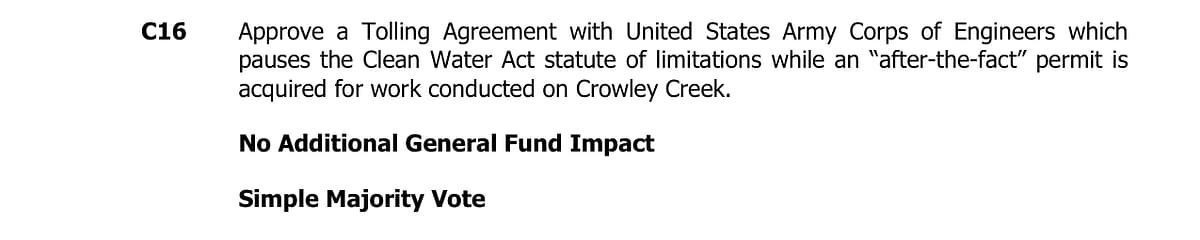
Item C16 asks the board to approve a "Tolling Agreement" with the U.S. Army Corps of Engineers over work done on Crowley Creek. Read past the bureaucratic name and the county's own staff report says something plainer: Public Works broke federal law, and everyone involved knows it.
Here's what happened, according to the county's own account. In late 2025, Public Works cleared vegetation along Crowley Creek near the First Street Bridge and then placed riprap, rock armor against erosion, along the bank. Only after the work was finished did the department learn it needed a Clean Water Act permit from the Army Corps before placing the rock. The Corps directed the county to apply for what's called an "after-the-fact" permit, and federal rules require anyone doing that to sign a tolling agreement: a legal pause button that stops the clock on the Corps' ability to sue while the retroactive permit gets sorted out. The county's own staff report spells out the alternative: decline to sign, and "the County could be subject to enforcement action for conducting unpermitted work."
Two details in the agreement itself are worth sitting with. First, the document doesn't name "Shasta County" as the party facing potential federal action. It names John Heath, the Interim Public Works Director, rather than the county as an institution, as the "potential defendant," even though he's also the official who signed off on the staff report asking the board to approve the fix. Second, the Corps' own paperwork calls the site "Crowley Gulch." The county calls it Crowley Creek. Same stretch of water, two names: one from the agency deciding whether to enforce the law, one from the department that broke it.
A Commissioner Removed, No Questions Answered
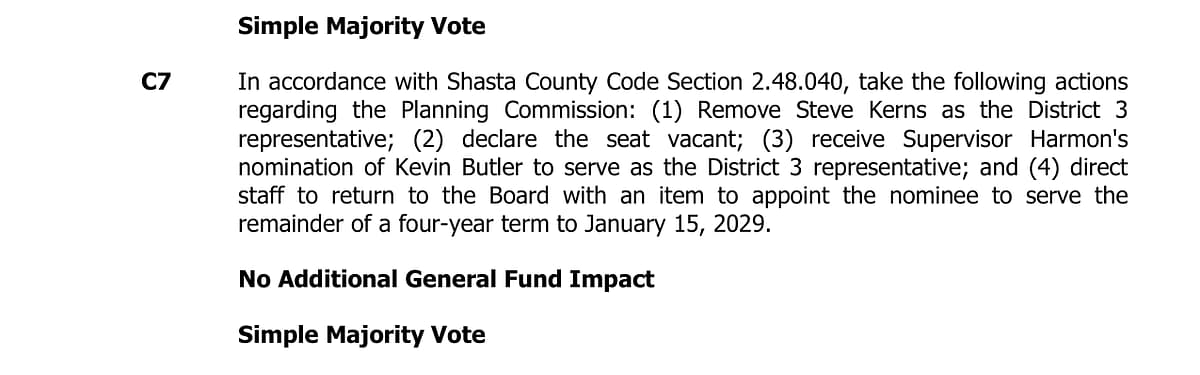
Item C7 removes Steve Kerns from the Planning Commission's District 3 seat, declares it vacant, and receives Supervisor Corkey Harmon's nomination of Kevin Butler to fill it, though the formal appointment itself, to a term running to January 15, 2029, comes back to the board as a separate item later. It cites Shasta County Code Section 2.48.040 as its authority. What it doesn't do, anywhere in the 500-plus-page meeting packet, is say why.
There is a staff report for this item, and it explains almost nothing. Two pages recite Shasta County Code Section 2.48.040, which lets the board remove a commissioner "at any time," and end in a single sentence of actual reasoning: "The District 3 Supervisor has decided to remove the current District 3 representative, Steve Kerns, and nominate Kevin Butler for the position." No cause is given. And Kerns was not some distant, lapsed appointee. He was seated and voting at the Planning Commission's July 9, 2026 meeting, six weeks before this removal, and those minutes are in this same 500-plus-page packet. He made the motion on the accessory-dwelling-unit ordinance the board is adopting Tuesday as R7, and seconded the motion on the Low Barrier Navigation Center ordinance the board is adopting Tuesday as R6. The board is being asked, in one packet, to enact two ordinances Kerns championed six weeks ago and to remove him without saying why.
The nominee taking his place is Kevin Butler, principal engineer and president of Butler Engineering Group, Inc., a Redding civil engineering firm. Butler's firm designed former Supervisor Patrick Jones's proposed High Plains Shooting Sports Center, the 151-acre gun range on the Millville Plains east of Redding that became one of the most contested land-use fights in recent county history. The Planning Commission voted 4-0 in April 2023 to recommend the zoning change that let the project move forward under a lighter environmental review. A judge later vacated that approval, ruling in March 2025 that the county should have ordered a full environmental impact report. That came after neighbors sued, and after the FPPC fined Jones and his campaign treasurer a combined $10,000 over an unrelated campaign-finance violation.
There's a second link between that project and this seat swap. Steve Kerns, the commissioner now being removed, recused himself from that same April 2023 vote on Jones's gun range, because his own firm had prepared the biological study that helped the project qualify for the lighter review a judge later found inadequate. The county is replacing a commissioner who stepped aside from Jones's gun range over a conflict of interest with one who represented it.
The Law Firm With No Ceiling Left

Item C8 raises the maximum hourly rate on the county's contract with Best, Best & Krieger, its longtime outside law firm, to $485, and, for the first time since the firm's total-compensation cap came off in 2022, builds in an automatic 2 percent raise every year starting in 2027.
The firm has represented the county since 2012. Fees didn't move for the first decade. Then, in 2022, the county lifted the total spending cap and set the rate at $350 an hour. Somewhere in 2024 the rate went up again, tied to inflation, though the county's own records don't say by how much. Tuesday's item is the third increase in four years. In every version of the fiscal-impact language the county has filed for this contract going back to 2012, the wording is the same: "the total amount to be paid will depend upon the number of hours involved." No document anywhere in county records puts a running total on what Best, Best & Krieger has actually billed Shasta County over fourteen years.
The firm's current work for the county includes defending it in River Ranch Neighborhood Association v. City of Redding, the CEQA lawsuit over the Eastside Road jail site the Sheriff walked away from earlier this month. The board voted 5-0 in March to hire BB&K attorney Sarah Owsowitz for that case specifically. Nothing ties the rate increase to that case (the staff report frames it as a routine periodic review), but it's a live reminder of what an uncapped hourly rate actually buys.
$560,940, and Nobody's Paid
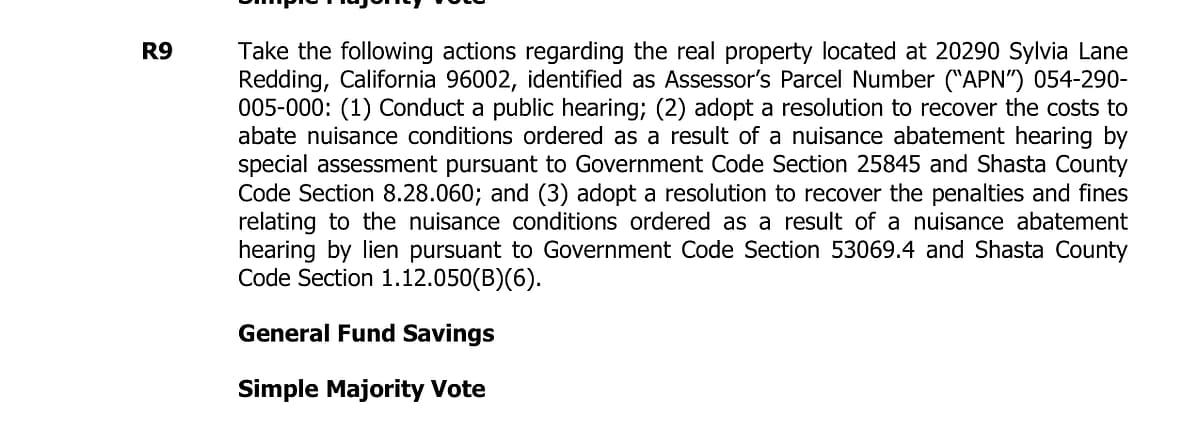
Four public hearings Tuesday, items R8 through R11, ask the board to formally recover the cost of cleaning up four Shasta County properties the county says had become chronic nuisances. Combined, the county wants $170,340.80 back in abatement costs and $390,600 in fines and penalties, a total of $560,940.80. So far it has collected nothing.
The starkest case is 20290 Sylvia Lane in Redding: a 9.27-acre parcel the county describes as a 55,000-square-foot junkyard with people living out of RVs and no working sewage system. Sheriff's deputies have been called to the property 125 times since 2019. It's been cited across three separate code-enforcement cycles going back to 2009. The county wants $212,737.06 back for it, the largest of the four asks. A property on Bambi Drive in Shingletown, with a failing septic system and its own history of prior violations, comes in at $162,562.59. A smaller lot off Rock Creek Road totals $54,196.45. And a 20-acre parcel on Modesta View Court in Anderson, the only one of the four where state environmental regulators actually joined a site visit and the only one where the owners, Amrit and Mohit Kulasekaran, showed up to their own hearing, which lasted several hours, totals $131,444.70.
All four demand letters went out the same day, July 1. All four owners owe the full amount, unpaid. It reads less like four separate cases reaching a conclusion on their own timelines and more like a backlog the county finally worked through together.
Two Zoning Ordinances, One Redo
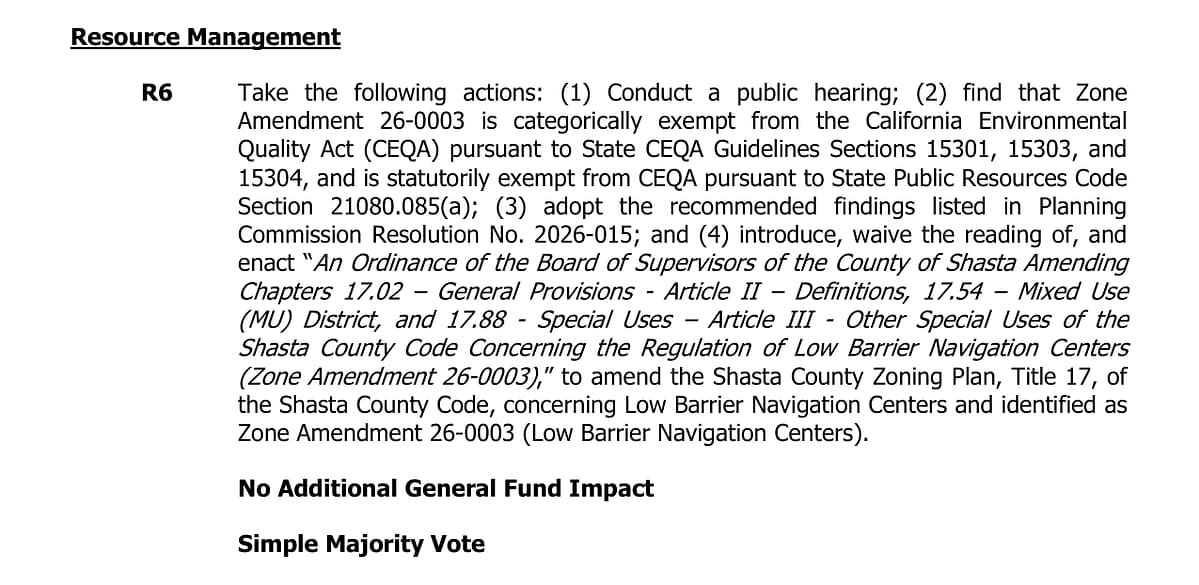
The board takes up two zoning rewrites Tuesday, both years in the making, both landing the same night for unrelated reasons.
Item R6 creates a path for "Low Barrier Navigation Centers," a state-defined category of homeless shelter that doesn't require sobriety as a condition of entry, to open in Shasta County's Mixed Use zoning district without a discretionary hearing. This isn't the county choosing to make room for a shelter; it's California state law requiring it. The county has had this ordinance on its to-do list since its last Housing Element update, and the state housing department has been pushing the county to finish it. No developer has actually proposed a navigation center in Shasta County; the ordinance clears the path before anyone's asked to use it. The Planning Commission approved it 3-1 in July. The lone no vote came from a commissioner objecting that the ordinance can't require sobriety, which is itself the state's rule, not the county's choice.
Item R7 rewrites the county's rules for accessory dwelling units, granny flats and in-law units, from scratch rather than amending the old ones. The rewrite has had a rockier road than most. A draft was pulled from the board's own agenda in May, and the board itself amended the ordinance in June to loosen size limits on detached units, a change staff estimated could make the resulting units $316 to $533 a month less affordable to rent than the stricter version, if built, according to a 2025 market study.
Letters From the County, on Someone Else's Behalf
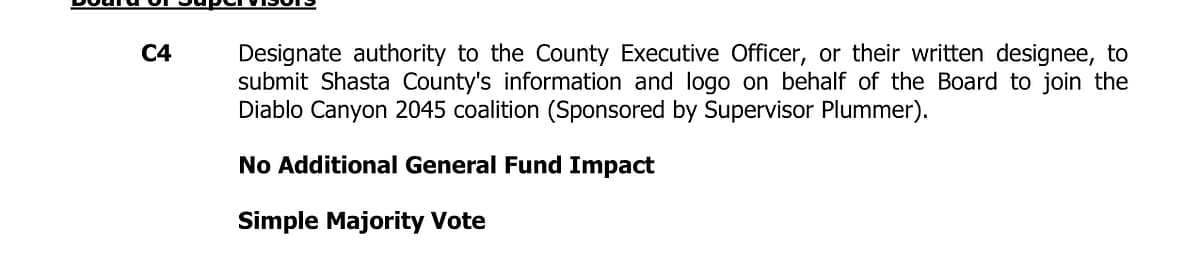
Three consent items ask the board to put Shasta County's name behind causes that have little to do with Shasta County government directly.
Item C1 opposes a state tax credit for sustainable aviation fuel, not because of jet fuel, but because the credit would divert money from the same pot of diesel excise tax revenue that funds local road repairs. It's a form letter: the California State Association of Counties urged member counties to oppose the credit and supplied the template this one is based on, estimating the cost to Shasta at $233,000 to $839,000 a year if it goes through as proposed. Public Works, which relies on that road funding, backs sending it.
Item C4, sponsored by Supervisor Matt Plummer, would have the county join something called the Diablo Canyon 2045 coalition, a campaign launched this spring to keep California's only nuclear power plant running past its currently authorized 2030 shutdown date, out to the end of its federal license in 2045. By its own August 5 count, the coalition has grown to 47 member organizations, 79 local elected officials, and two county boards of supervisors. California Assemblymember Dawn Addis has publicly warned the coalition is "largely funded by non-government and private entities" whose interests "may not fully align" with residents'. Shasta County joining would make it one of only a handful of county governments, rather than individual elected officials, on the coalition's roster. Plummer's 2024 campaign received a $200 contribution from PG&E Corporation, the utility that operates Diablo Canyon and stands to benefit most directly if the plant stays open.
Item C5, sponsored by Board Chair Chris Kelstrom, backs a pair of companion bills in Congress, H.R. 7296 and S. 3752, both called the SAVE America Act, that would require proof of citizenship to register to vote and photo ID to vote in federal elections. Both bills are real, both are still sitting in committee with no vote scheduled, and the letter is addressed not to Shasta's own representatives in Washington but directly to the bills' sponsors in Texas and Utah.
The Story Not on This Agenda
None of it is on Tuesday's agenda, but it's worth watching for anyway. Registrar of Voters Clint Curtis has spent the past week trying to hire Tina Peters, the Colorado elections clerk convicted of tampering with voting machines and recently released from prison on parole, as a consultant, drawing a formal letter of objection from two U.S. Senators and a public statement from California's Secretary of State calling the idea "simply outrageous." At the same time, both unions representing Curtis's own elections staff have now gone on record with formal votes of no confidence, calling for his resignation. Public Comment Period – Open Time is open to any matter not on the printed agenda within the board's jurisdiction, and representatives from both unions have said they intend to press the board on it, so don't be surprised if Tuesday's meeting ends up being about Curtis anyway, even though his name appears nowhere on the printed agenda.
Also on Tuesday
A youth substance-use program's third checkup. C.O.R.E., the joint opioid-settlement-funded program run by Youth Options Shasta and Raising Shasta, returns for its third bi-annual status update. The program's funding and the committee-conflict questions around it were reported here in depth last month; nothing about Tuesday's presentation changes that record.
A rural mental-health contract grows. Hill Country Community Clinic's "Circle of Friends" program, serving Eastern Shasta County, gets a six-month extension and a $193,488 increase to its contract ceiling, funded by moving opioid-settlement dollars into the county's alcohol and drug programs budget.
A grant-writer, a tax rate, and a fire contract. The county would hire a firm to help chase grants, adopt next year's countywide tax rate, and approve routine contracts for fire suppression services, a bridge project's environmental review, and a tire-cleanup grant.
Presentations and updates. A presentation on veteran homelessness in Shasta County, a briefing on how federal budget changes could hit county services, a 50th-anniversary honor for Sierra Pacific Industries' Shasta Lake mill, and the CEO's standing legislative update round out the non-consent calendar.
The Pattern Under the Vote
Nothing on Tuesday's agenda required a scandal to happen. That's what makes it worth reading closely. A Public Works department wrote down, in its own staff report, that it broke federal law, and the fix is a two-paragraph consent item. A Planning Commissioner disappears from a packet with no explanation anyone thought worth writing down. A law firm's hourly rate goes up with a raise built in for years the board won't be voting on individually. Four property owners have owed the county money since July and paid none of it. This is what accountability looks like when nobody's watching closely enough to ask for it, not a cover-up, just paperwork that assumes no one will read it. Tuesday, someone did.
And that's the Agenda Preview.