

The Censure Comes Back, and the Money Runs Out: Tuesday August 11th 2026 Shasta County Agenda
 By Benjamin Nowain•August 11, 2026•12 min read
The Shasta County Board of Supervisors meets Tuesday, August 11, with the heaviest agenda of the summer — and the opposite of last month's housekeeping. The board will decide, at last, whether to formally censure its own elected Clerk/Registrar of Voters. It will hear a progress report from an opioid-settlement grantee that has already spent every dollar of its award, with half the contract still to run. And behind closed doors, it will take up two lawsuits: one over a jail site the Sheriff publicly walked away from six days ago, the other a roughly $56 million claim against the sitting District Attorney that a judge dismissed on Friday, with the county now going after the former supervisor who brought it for its costs. Down on the consent calendar, where items pass in a single vote without discussion, sit three contracts the county signed after the work had already started, and one contract whose vendor gave money to a sitting supervisor four and a half months before Tuesday's vote.
The Censure, Round Three
Item R5 asks the board to "consider adopting a resolution of censure" against County Clerk and Registrar of Voters Clint Curtis "for substantiated findings of managerial misconduct following an investigation."
The word "investigation" undersells it. There are two, and the county has already released both in full, in response to a public-records request. The first, by the outside firm Oppenheimer Investigations Group in March, sustained findings that Curtis made campaign calls on county time, made violent and demeaning remarks in the workplace, publicly admonished a subordinate, and retaliated by restricting an employee's duties. The second grew out of what happened next. The afternoon of March 26, Curtis received notice that the first investigation had closed, a document that named one staffer's treatment among the sustained findings. The following day, according to the county's own report, Curtis banged on an employee's door and was overheard saying he would have HR "pull her out of the office by her hair." The county's Director of Support Services, Monica Fugitt, investigated, found the statement more likely than not to have been made, and more likely than not to be retaliation for the employee's participation in the first investigation, and delivered her report April 24.
That April report is the document to hold Tuesday's vote against. County Personnel's written recommendation was explicit: public censure, framed as the only remaining option for an official the board cannot suspend, demote, or fire, because three board members appointed him, plus the physical separation of Curtis from his staff, with a workplace restraining order flagged as the next step if the behavior continued. The board has already acted on part of that: it voted in May to provide legal representation to affected staff, and Fugitt deployed county staffers into the elections office as monitors. Curtis refused the physical separation.
The censure itself has been circling for months. Last October 14, the board unanimously condemned Curtis over his treatment of the press, and warned, on the record, that further misconduct would mean censure. In April, with the reports in hand, the board discussed censure and delayed. On June 23, on a motion by Supervisor Allen Long, seconded by Matt Plummer, the board voted to take it up again once the June election was certified, with Kevin Crye the lone no. It did not appear on a July agenda, which turns out to have a mundane explanation: the June 23 direction was verbal: it appears nowhere in that meeting's written agenda or packet. Long's amendment barred discussion until after certification, and staff needed the interval to build the resolution package. Now it is back, with the findings written into the resolution's own recitals.
What the resolution would actually do is the asterisk. Its operative language "determines," "serves as a formal statement," and "requests" — no penalty, no funding consequence, no removal mechanism appears anywhere in it. Crye said it plainly in April: censure is "toothless and a waste of time." The counting question for Tuesday: Long and Plummer have been consistently pro-censure; Crye consistently against; Chris Kelstrom said in April that "if 10% of those allegations are true... you deserve a censure," then moved the April vote to put the matter off, and in June backed bringing it back only once the results were certified. Corkey Harmon said in April that "there is not enough evidence, and I cannot vote to censure," the clearest no after Crye, and the vote most likely to have moved now that both reports are public.
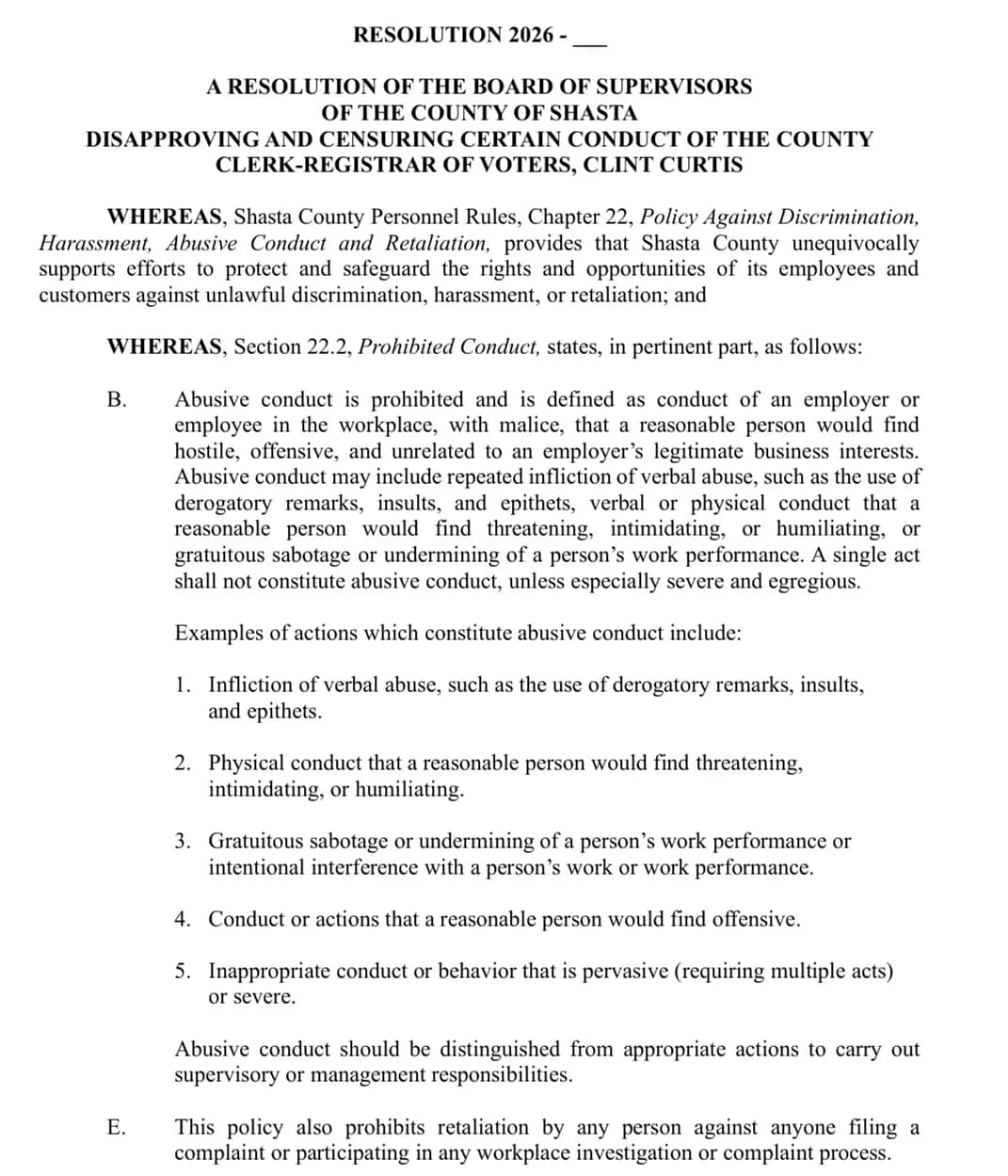
The draft censure resolution in Tuesday's packet: its operative clauses “determine,” “state,” and “request”: no penalty appears anywhere in it.
Curtis, for his part, is not planning to absorb the blow quietly. In a text to the Record Searchlight the day before the meeting, he said a censure could prompt him to sue the county, for defamation and a "hostile work environment," rather than the elections employees he blames, and said he will show a video at Tuesday's meeting that he claims documents "the type of sabotage I have been dealing with the whole time." Plummer's response, to the same outlet: a defamation claim would require the censure to be based on false information, and both investigations substantiated the findings.
Whatever happens, it lands on an official already on his way out. Curtis lost the June election to Joanna Francescut, who took roughly 58 percent of the vote, and whom two supervisors had preferred over him when the board appointed him in May 2025. But he holds the office until January 2027. Last week came the coda: Curtis applied for the registrar's job in Kern County, and, per reporting five days before this vote, didn't get it. And the backdrop kept moving this week even without him: on Friday, a Shasta County judge suspended Measure B, the elections overhaul voters passed in June, while the lawsuit brought by the Attorney General and Secretary of State proceeds. The ruling was delivered orally; the written order is still to come.
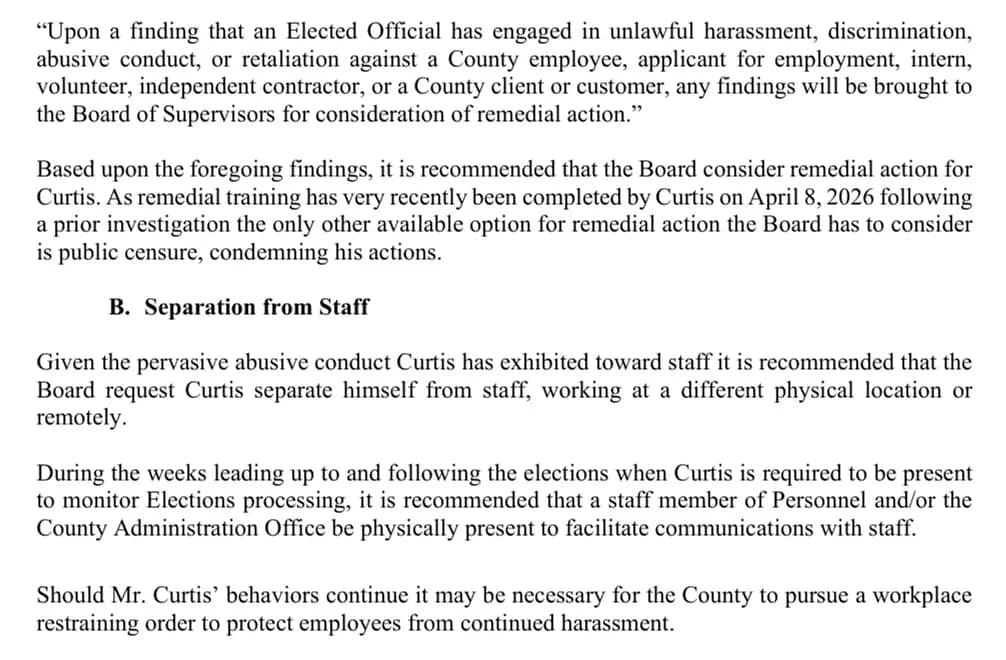
County Personnel's April recommendation, from the investigation report the county released under a public-records request: censure as the only remaining option, separation from staff, and a restraining-order warning if the behavior continued.
A Presentation With the Money Already Gone
Item R4 is a no-vote presentation from Our Heroes' Dreams, the veterans' peer-support nonprofit the county awarded $250,000 in opioid-settlement money in February, on its programs for veterans experiencing homelessness.
The organization's own slides do the newsworthy part. By its own accounting, Our Heroes' Dreams billed $249,852, effectively all of it, in the first five and a half months of a twelve-month agreement. One slide states it outright: 46 percent of the contract term used, 100 percent of the funding used, six and a half months of the term "unfunded." The slides attribute the pace to caseload growth, from six veterans in December to a steady 14 to 15 a month by spring. What the packet does not contain is a plan for the unfunded half of the contract.
The presentation itself is the closest thing to the reporting the board was promised. When the award was approved in February, Supervisor Plummer asked for six-month or annual impact reporting, and founder Justin Bond agreed on the record. The written agreement requires less: status updates "upon request." Tuesday's appearance is arguably the first — and it arrives after the money is gone, not on any cadence.
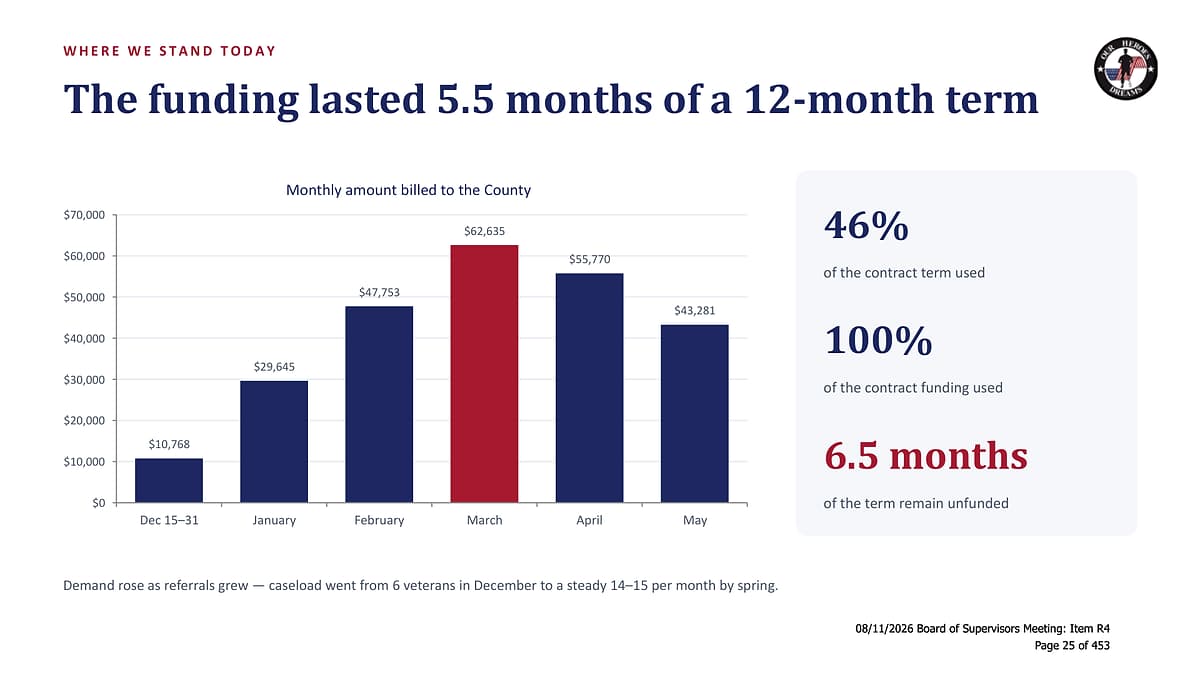
Our Heroes' Dreams' own slide to the board: 100 percent of the funding used at 46 percent of the contract term.
Closed Session: The Site the Sheriff Just Gave Up, and the $56 Million Suit a Judge Just Ended
The board's 45-minute closed session covers two cases, and both are bigger than the agenda line suggests.
The first is the River Ranch Neighborhood Association's lawsuit over the county's planned "Alternative Custody Campus" on Eastside Road: the 90-acre site the City of Redding agreed to lease to the county for $1 a year, with a $1 purchase option, for a project that was to include a 100-bed reentry program and, eventually, a 1,200-plus-bed jail to replace the 1984 downtown facility. The neighborhood sued in February, arguing the agencies approved the lease without environmental review of the full correctional build-out. Then, last Wednesday, six days before this closed session, Sheriff Michael Johnson announced at a packed community meeting that the county is abandoning the Eastside Road site altogether, citing neighborhood opposition and an environmental review that found sensitive habitat requiring costly redesign. About 150 people attended; the announcement drew cheers.

What no one has said publicly is what happens to the lawsuit. No outlet has reported it dismissed or settled, and it is still on Tuesday's closed-session list, which is likely the point: with the site gone, the board's discussion is presumably about the exit, whether that is dismissal, fees, settlement terms, or starting over somewhere else. The Sheriff says the reentry and jail concepts themselves still stand; a new site will be sought.
The second case, Jones v. Bridgett, was live when the agenda was printed — and died four days before the meeting. Patrick Jones, the former District 4 supervisor who lost his seat in 2024, had sued District Attorney Stephanie Bridgett and the county, alleging she and her office used county-paid time and resources to run her 2022 re-election campaign; reported damage claims totaled roughly $56 million. On Friday, a Butte County judge, sitting because every Shasta County judge recused over prior professional dealings with the DA's office, sustained the county's and Bridgett's demurrers without leave to amend, ending the case at the pleading stage. The court found the claims failed as a matter of law: an individual taxpayer's general grievance isn't the concrete, particularized injury a suit like this requires. The ruling never reached the underlying factual dispute: an earlier county-commissioned investigation had found Bridgett performed limited campaign activity on county property but described the violations as minor, a review Jones criticized as interviewing just five of roughly 70 employees. The county, which defended Bridgett over Crye's lone dissent, is now seeking its costs and, per reporting, its attorney's fees from Jones. What remains for Tuesday's closed session, presumably, is the endgame: costs, any appeal exposure, and closing the file.
One more documented fact belongs in that story: across 2025, four separate public-records requests reached into the Bridgett matter: her campaign-finance records, an office purchase, the outside investigator's invoice, and, in December, the whistleblower investigative report itself. Every one of them closed with zero documents released.
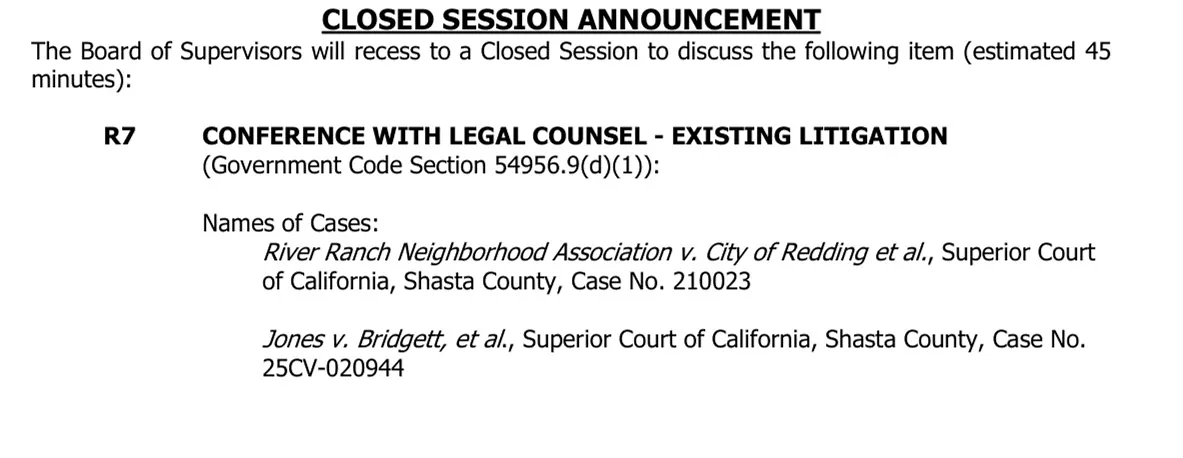
The closed-session list on Tuesday's agenda: River Ranch and Jones v. Bridgett.
On Consent: a Contribution, Then a Contract
Item C18 would award Redding Advertising, Inc. (the local firm doing business as Media Plus Advertising and Marketing, whose president, per the county's own contract, is Chris Zwaga) up to $155,000 for an impaired-driving education campaign, the marketing arm of the $423,612 CHP grant the board accepted two weeks ago.
Here is the part that warrants a disclosure conversation before the vote: on March 28 of this year, "Media Plus" put $450 into Kelstrom's re-election committee in three same-day entries, per the committee's own Form 460: two monetary contributions totaling $408, plus a $42 entry the filing itself records as a "Cake Auction" purchase, sitting among other auction receipts from what appears to have been a campaign fundraiser that day. The two contributions alone clear the Levine Act's $250 threshold. That is inside the twelve-month window of the Levine Act, the state law printed as a standing notice on this very agenda, which requires disclosure, and can require recusal, when a party to certain proceedings has given a board member more than $250 in the preceding year. Whether the Act's definitions reach a contract of this kind is a question for County Counsel; whether Kelstrom discloses or steps aside Tuesday is a question the meeting itself will answer. The contribution is filed under the business's name; the filings do not identify which individual made it.
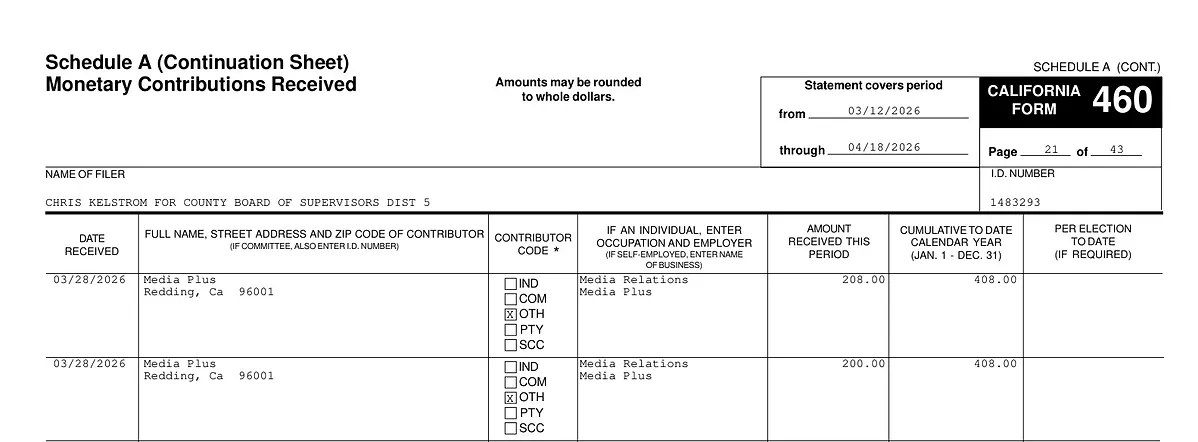
The Kelstrom committee's Form 460, Schedule A: two Media Plus contributions, March 28, 2026: $408 cumulative, above the Levine Act's $250 threshold.
Media Plus is a fixture of local campaign advertising generally: its client list in county filings spans committees across the spectrum, including, as it happens, Clint Curtis's 2026 campaign, which paid the firm about $3,300. Money in both of Tuesday's marquee stories runs through the same small-county vendor — in opposite directions.
Three Retroactive Contracts, and a Resolution to Allow More
Consent items C7, C8, and C9 are all agreements signed after the fact: $1,583,225 in total. C7 renews the county's parent-education contract with the Shasta County Child Abuse Prevention Coordinating Council, dba Raising Shasta ($933,225 over three years), the same parent nonprofit that received $3 million in opioid-settlement money in May 2025, a grant recommended by the county's CORE committee at a time when, as we reported last month, two of that committee's four members were the executive directors of the two organizations that received the entire $4 million, Raising Shasta's among them. Tuesday's contract is different money, federal family-support funds rather than opioid dollars, and this organization's finances are checkable: its parent files a full Form 990, showing a 10.2 percent administrative ratio and modest officer pay, with the overwhelming share of spending on programs. C8 and C9 are the starker pair: $450,000 and $200,000 for emergency residential mental-health placements for Shasta youth, with a provider based in Solano County and at a Modesto group home, hundreds of miles away, where, per the staff reports, services began before any agreement existed, both retroactive for the same stated reason. Two contracts, same shape: when a Shasta child is in psychiatric crisis, the county places them out of county, and the paperwork catches up later.
Then comes C10, which would make catching-up-later official: a resolution authorizing the HHSA Director to sign future housing-program agreements and amendments, "including retroactive" ones, without returning to the board, so long as they comply with county contracting policy.
Two more consent items carry real numbers. C19 retroactively amends the jail's inmate-phone contract to comply with a new state rate cap that mirrors the federal order: calls drop from 7 to 4.5 cents a minute, and the county's cut, 60 percent of call revenue plus a share of tablet fees (an arrangement a national prisoner-rights group pulled the underlying contract on this year through a records request), shrinks with it. And C20 raises the sign-on bonus for a Chief of Psychiatry the county has failed to recruit: to as much as $100,000, at the CEO's discretion. The staff report says the failed December bonus was $30,000; the board's December action, as recorded at the time, set it at $15,000. Either way, the position is still empty, and the county says it is paying significantly more to contract the work out in the meantime; by how much, the staff report doesn't say, and no figure appears anywhere in the packet.
Also on Tuesday
An evergreen software contract (C16). Resource Management would move its food-facility and hazardous-materials permitting onto Tyler Technologies cloud software. A forced move, not an upgrade: the county's current permitting system is also a Tyler product, and Tyler is switching it off at the end of 2026, with the staff report's stated fallback being paper inspection reports and an unsupported Access database. The new agreement starts at about $22,500 a year beginning January 2027, bought through a cooperative purchasing agreement rather than a local competitive bid, and renews automatically at Tyler's then-current rates unless the county cancels.
A lease with real money behind "no impact" (C1). The CEO would sign a roughly five-year lease at 5830 Westside Road for the Probation Department's Juvenile Division offices: about $200,000 over the initial term by the lease's own rates, and roughly double that if all five renewal options are exercised. The county's staff report and the lease text disagree by $55 a month on the base rent, so treat the totals as approximate; either way it is state funds, not the general fund.
The CEO's pen (C6). Nested inside a routine support letter for a federal small-business bill: authority for the CEO to submit future letters "on the Board's behalf so long as changes do not substantially alter its intent": a standing delegation of the board's legislative voice, with no elaboration anywhere in the staff report. Paired with C10, it makes two open-ended delegations of board authority on a single consent calendar.
Food trucks (C14). A resolution of intention to finally write mobile-food-facility rules into county zoning, with interim code-enforcement guidance in the meantime.
Letters and appointments (C5, C3, C4, C11). The county would withdraw its opposition to a state appliance-recycling bill after amendments resolved its concerns, and make three routine appointments: a cemetery-district trustee, an economic-development representative, and a water-management committee member.
Honors and updates (R1, R2, R3, R6, C15). Employee of the month, Firefighter Appreciation Day (August 18), a student-council presentation, the CEO's standing update, and a $333,023 budget amendment moving grant money into cleanup programs racing an end-of-2026 federal spending deadline.
The Pattern Under the Vote
Tuesday's headline item is the board using the strongest tool it has against an elected official it cannot fire: a resolution that, by its own text, requests and states but cannot compel. The rest of the agenda shows the same machinery pointed the other way: a grantee reporting its money already spent with half the contract term to run; contracts ratified after the work began, and a resolution to keep doing so; a vendor's contribution sitting quietly upstream of its contract. None of it is a scandal on its own. Together, it is a picture of where accountability in Shasta County government currently binds — and where it doesn't.
And that's the Agenda Preview.