

Shasta Supervisors to Consider Amended Jail Health Contract, Cottonwood Sewer Fee Hike, and Public Works Director Appointment Tuesday 4-07-2026
 By Benjamin Nowain•April 7, 2026•11 min read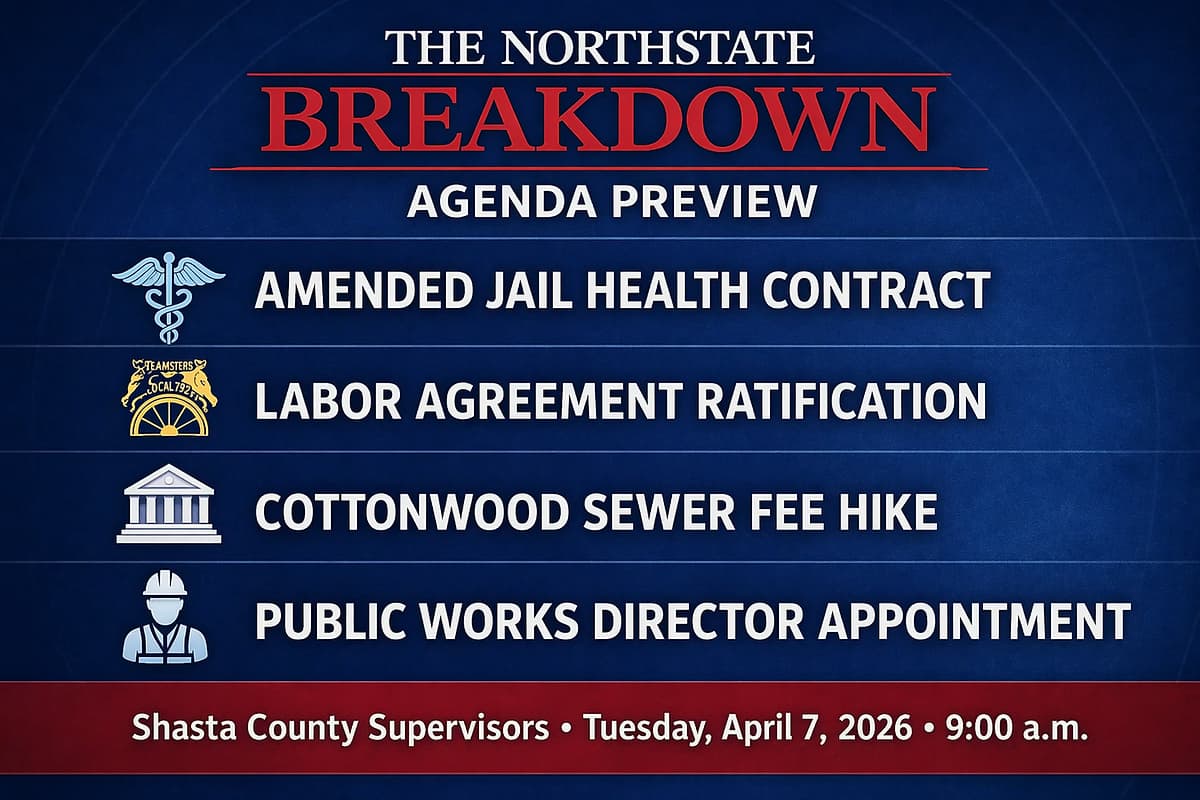
The Shasta County Board of Supervisors meets Tuesday for its regular session, with an agenda headlined by an amendment to the new Mediko jail healthcare contract that would move the transition one month earlier than planned, a two-year labor agreement with professional county employees after nine months at impasse, a public hearing on a dramatic fee increase for Cottonwood's sewer system, and a closed-session appointment to fill the county's Public Works director post ahead of a 35-year employee's retirement.
The board will also send formal letters to the governor and Legislature urging state funding to buffer local impacts of the federal "One Big Beautiful Bill," formally acknowledge the completion of a 49-unit affordable housing project in the City of Shasta Lake funded by wildfire disaster relief dollars, and receive a presentation on a new mobile probation van that will serve rural communities from Burney to Cottonwood.
Here is a look at the major items on the agenda.
MEDIKO JAIL HEALTH CONTRACT AMENDED TO START A MONTH EARLY (C19)
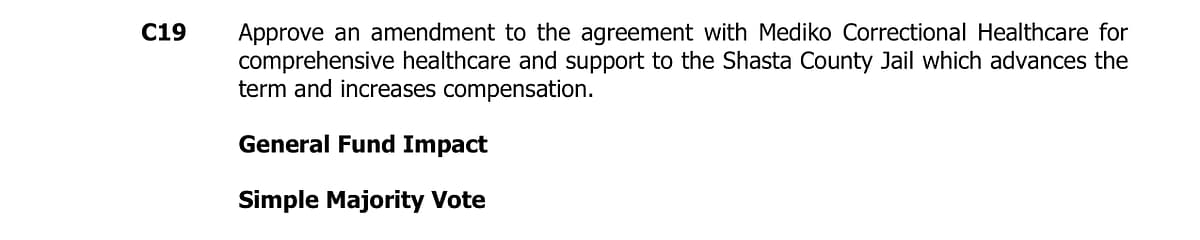
Less than four weeks after unanimously approving a new jail healthcare contract with Mediko Correctional Healthcare, the board is being asked to amend that agreement to move the start date up by one month — from July 1 to June 1, 2026.
The board approved the original Mediko contract on March 10, following a presentation by Sheriff Michael Johnson in which he told supervisors that Shasta County had seen eight people die while in custody between December 2023 and December 2025, with a ninth in January of this year. "We've had more than our share of in-custody deaths and litigation for medical-related incidents within that jail," Johnson said at the time. The board voted unanimously to enter into the contract despite the price — approximately $3 million more annually than the county's existing provider — with Supervisor Matt Plummer saying the additional cost was worth it to improve care and reduce litigation exposure.
Mediko, a Virginia-based company, will provide comprehensive healthcare, Medication-Assisted Treatment services, and Jail-Based Competency Treatment programming at the Shasta County Jail. According to Tuesday's staff report, transition discussions with the current provider have been going smoothly: Mediko is ready to begin June 1 and the outgoing provider has agreed to terminate its agreement one month early. Savings from the early termination will offset the additional month of Mediko compensation, meaning no new fiscal impact to the county.
The amendment carries a general fund impact designation, consistent with the original contract, and requires only a simple majority vote. It sits on the consent calendar and would normally be approved without discussion.
COUNTY AND PROFESSIONAL EMPLOYEES SETTLE LABOR DISPUTE AFTER 9-MONTH IMPASSE (C20)
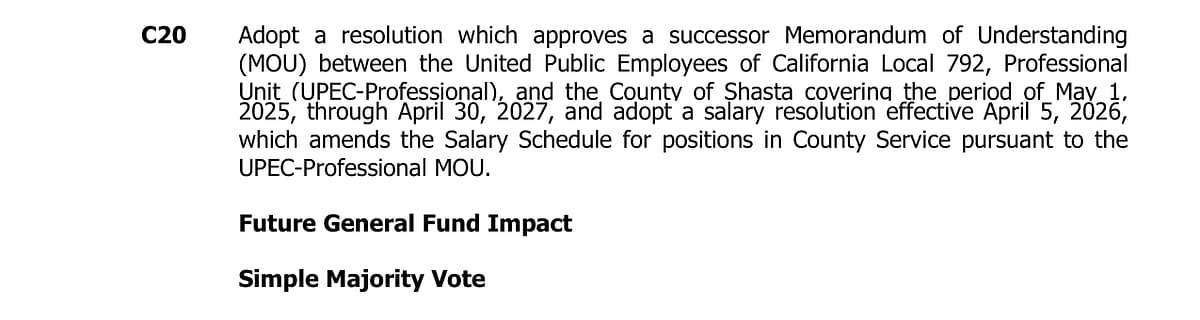
After nearly a year of failed negotiations, the county and one of its professional employee unions have reached an agreement — and the board is being asked Tuesday to formally ratify it.
The United Public Employees of California Local 792, Professional Unit — a bargaining unit affiliated with LIUNA, AFL-CIO — represents professional-class county employees including social workers, engineers, and other credentialed staff. Negotiations for a successor Memorandum of Understanding began in February 2025, and the previous agreement expired April 30, 2025. Talks broke down quickly: the county issued a Last Best and Final Offer on May 27, declared impasse on June 13, and participated in formal mediation on July 18 — which was unsuccessful. The parties remained at impasse for the following eight months.
The logjam broke in early March. The county sent UPEC-Professional a concept proposal outlining its outstanding offers on March 4. The union voted to accept, and the parties reached tentative agreement on March 13 — nine months and a failed mediation session after the prior contract lapsed.
The successor MOU covers May 1, 2025 through April 30, 2027 — meaning much of the agreement period has already elapsed. Under the settlement, employees receive a 2 percent cost-of-living increase effective April 5, 2026, and a second 2 percent increase effective May 3, 2026, four weeks later. The agreement also adds bilingual pay of $80 per pay period for employees regularly assigned to use a second language, establishes callback pay at time-and-a-half for a minimum of two hours, provides up to $1,000 per year in educational reimbursement, and offers $9 per day in parking reimbursement for employees working in downtown locations. The number of authorized union stewards will grow from six to eight, reflecting a 2022 unit modification that expanded the bargaining unit's membership.
The total two-year cost of the agreement is approximately $1.77 million in salary and benefits increases. Of that, only about 21 percent — roughly $371,000 — comes from the General Fund. The remaining 79 percent is covered by grants, state realignment revenues, and reimbursement agreements that fund the departments where most UPEC-Professional members work. The county's lead labor negotiator throughout the process was Gage Dungy, a partner at the firm Liebert Cassidy Whitmore.
COTTONWOOD SEWER FEES TO QUADRUPLE UNDER PROPOSED ORDINANCE (R5)
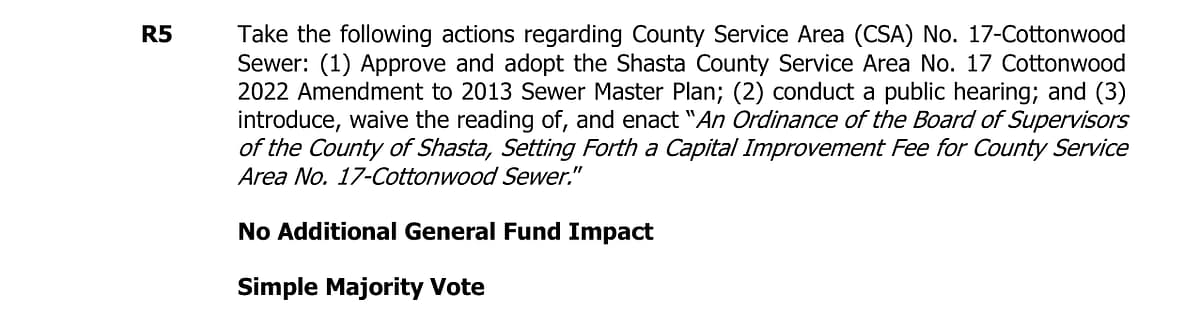
The board will hold a public hearing Tuesday on a proposal to increase the Capital Improvement Fee for the Cottonwood sewer system by more than 350 percent — from $6,279.19 to $28,300 — with the fee to adjust annually by a construction cost index going forward.
County Service Area No. 17 provides sewer service to 1,436 customers in downtown Cottonwood, representing 1,703 household equivalents. The system was built in the 1980s after septic problems emerged in the area and state regulators required action. The Capital Improvement Fee — charged when new development connects to the system or when existing property owners need more capacity than originally allocated — was last updated in 2005. It has not been re-evaluated in 21 years.
The case for the increase comes partly from environmental pressure. The system discharges into Cottonwood Creek, and the California Regional Water Quality Control Board has indicated that increasing discharges beyond the existing design capacity are unlikely to be approved, citing limited capacity to absorb copper and zinc. Regulators have also expressed concern about the existing level of discharge given decreasing creek flows. At the same time, the current system is approaching its design capacity, and grant funding is not available for wastewater system expansion.
The county hired Pace Engineering in 2022 to study five options for handling additional development. All five require significant infrastructure improvements. Staff is recommending the board adopt an ordinance setting the new fee and adjusting it annually by the Engineering News Record construction cost index — a benchmark that tracks actual construction costs rather than general inflation, which has run well below construction cost increases in recent years.
If the board declines to act, staff warns that a moratorium on new development within the Cottonwood sewer service area may soon be required. The item is in Supervisor Chris Kelstrom's District 5. Community members who want to speak on the proposal must do so during the public hearing portion of the meeting.
LETTERS TO GOVERNOR, LEGISLATURE URGE STATE BACKSTOP FOR FEDERAL BUDGET CUTS (C7)
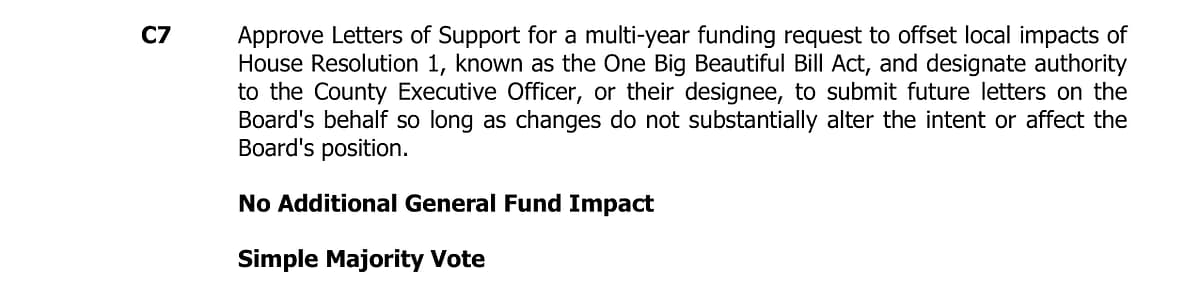
The board will send formal letters Tuesday to Governor Gavin Newsom, the California Senate, and the California Assembly requesting that the state step in to buffer local impacts of the federal budget reconciliation package known as the "One Big Beautiful Bill Act," with the California State Association of Counties setting April 7 as the advised deadline for submission.
The concern is direct and fiscal: the federal legislation is expected to shift the cost of health and human services programs from the federal government to states and counties. Shasta County, working with CSAC and its Health and Human Services Agency, estimates that the statewide impact on county budgets could reach between $6 billion and $9.5 billion annually once the changes are fully implemented. The primary driver is indigent care — counties are mandated under California law to provide basic healthcare to low-income residents who have no other coverage, and with approximately one million Californians estimated to lose Medi-Cal under the new rules, that demand is expected to surge.
As of December 2025, approximately 66,552 Shasta County residents are enrolled in Medi-Cal — roughly one in four county residents. The letters ask the state to respond with $1.9 billion in county funding for fiscal year 2026-27 and $4.5 billion in 2027-28. County Executive Officer David Rickert previewed the CSAC campaign and its funding framework at the March 24 board meeting. Tuesday's action formally locks in Shasta County's position letters before the deadline.
The item also grants the CEO authority to submit future related letters on the board's behalf without requiring a return vote, so long as the substance does not substantially change.
CASCADE VILLAGE HOUSING PROJECT COMPLETE AFTER $15.9 MILLION IN FEDERAL INVESTMENT (C9)
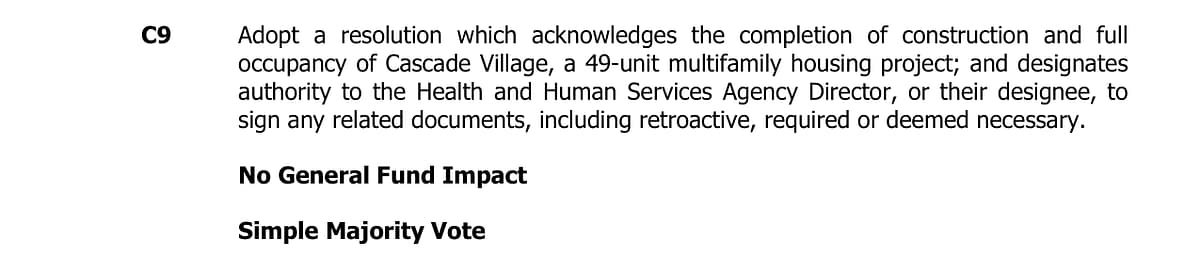
The board will formally acknowledge the completion and full occupancy of Cascade Village Apartments, a 49-unit affordable housing project in the City of Shasta Lake built through a partnership between the county's Housing and Community Action Agency and developer Shasta Lake Downtown Housing, LP.
The project was funded through the Community Development Block Grant — Disaster Relief Multifamily Housing Program, a federal mechanism that directs rebuilding dollars to areas impacted by presidentially declared disasters. Cascade Village qualified because of Shasta County's 2018 wildfire disasters. The county's HCAA signed an initial grant agreement with the California Department of Housing and Community Development in October 2021 for $4.28 million. That figure grew with two subsequent amendments — including a second amendment signed just six weeks ago, on Feb. 19, 2026, that added $10.84 million — bringing total project funding to $15.86 million. All units serve households earning less than 80 percent of the Area Median Income.
Tuesday's resolution is primarily administrative: it documents the completion of the construction phase, confirms full occupancy, and authorizes HHSA to sign any remaining grant documentation.
HOUSING REPORT SHOWS PERMITS AT 6-YEAR LOW, CARR FIRE REBUILD STALLING (C18)

Also on the consent calendar, the board will accept the county's 2025 Housing Element Annual Progress Report — a state-mandated annual accounting of residential construction activity in the unincorporated county.
The numbers reflect a continuing slowdown. Shasta County issued 77 building permits for new dwelling units in 2025, down from 114 in 2024, 105 in 2023, 200 in 2022, 206 in 2021, and 211 in 2020. It marks the fifth consecutive year of decline and the lowest total in the current 2020-2028 Housing Element cycle — a drop of 63 percent from the cycle's opening year.
The 77 permits included 41 single-family homes, 16 manufactured homes, and 20 accessory dwelling units. Of those, 13 were issued to replace dwelling units destroyed by wildfires — 12 related to the Carr Fire and 1 to the Zogg Fire. The pace of fire rebuilding continues to slow. Of 817 dwelling units lost in the unincorporated county in the Carr Fire, building permits have been issued to replace 398 — fewer than half, more than seven years after the fire.
None of the new single-family homes permitted in 2025 could be demonstrated as affordable to low-income households. Only five were affordable to moderate-income households. The remaining units were priced for above-moderate income buyers.
PROBATION VAN TO BRING SUPERVISION SERVICES TO RURAL COMMUNITIES (R4)

The board will receive a presentation from Chief Probation Officer Tracie Neal on the county's new Mobile Probation Vehicle, purchased with a $280,566 competitive grant from the Board of State and Community Corrections. Shasta County was one of only three northern California counties to receive funding under the program, which supports innovative strategies for removing access barriers faced by people on probation who are unhoused or living in rural areas.
Shasta County spans more than 3,800 square miles. According to the staff report, approximately 31 percent of adult probationers live outside the county's three incorporated cities, and an estimated 20 percent are experiencing homelessness. Travel to Redding for mandatory check-ins and treatment appointments creates compliance barriers that can result in technical violations — not because a person has reoffended, but because they could not get to an appointment.
The van is equipped with workstations, virtual treatment capabilities, and meeting space. It will operate on a structured monthly schedule: Shingletown on the first Tuesday; Burney, Fall River Valley, and McArthur on the second and fourth Tuesdays; Shasta Lake on the third Tuesday; Lakehead on the first Thursday; French Gulch, Whiskeytown, and Keswick on the second Thursday; Igo, Ono, and Happy Valley on the third Thursday; and Anderson and Cottonwood on the fourth Thursday. The item is sponsored by Supervisor Kelstrom.
CONSENT CALENDAR HIGHLIGHTS
Several other consent items are worth noting.
C1 — Elections Office Lease Renewal: The board will renew a one-year lease at 1643 Market Street, the home of the County Clerk and Elections Office since March 1991 — a 35-year tenancy in the same building. The lease covers 13,000 square feet at $16,803.42 per month, up slightly from the current $16,396.78, with four annual extension options. The current lease expires June 30, 2026, directly overlapping with the 2026 primary election season. Staff notes that no resources were budgeted to relocate the department, and losing the space could disrupt election operations.
C21 — Faster Action on Blighted Commercial Properties: The Treasurer-Tax Collector is asking the board to repeal a 2005 resolution and restore the state's default three-year timeline — rather than the county's current five-year timeline — for selling tax-defaulted non-residential commercial property at public auction. The five-year period was adopted in 2005 because the county's property tax system at the time could not distinguish residential from commercial parcels. That limitation no longer exists. Shortening the timeline from five years to three allows the county to move more quickly on tax-delinquent commercial properties.
C3 — Military Retirement Tax Exclusion: Sponsored by Supervisor Kevin Crye, the board would support Senate Bill 1407, which would exclude military retirement pay and survivor benefit pay from California personal income tax.
C5 — VA Benefits Fraud Protection: Sponsored by Supervisor Kelstrom, the board would support House Resolution 1732, the GUARD VA Benefits Act, targeting unaccredited representatives who defraud veterans of VA benefits.
C6 — Juvenile Treatment Facilities: Sponsored by Supervisor Allen Long, the board would support Senate Bill 1157 related to juveniles in secure youth treatment facilities. Long attended the county's Juvenile Justice Coordinating Council meeting in March, where the board approved an updated Juvenile Justice Plan addendum.
C11 & C12 — IT Contracts Through 2032: The board will approve a Checkpoint Cloud Email Gateway cybersecurity subscription through Six Degrees Consulting and VMware Cloud Foundation licenses through CDW-G, both with six-year authority through April 30, 2032. Both items waive competitive procurement requirements through existing state and national cooperative purchasing agreements.
C17 — Road Mileage Certification: The board will adopt a resolution certifying that Shasta County maintains 1,179.437 miles of road — an annual certification that affects state and federal funding formulas.
CLOSED SESSION
The board will recess to closed session for an estimated 30 minutes to address three items.
Under Item R6, supervisors will discuss two cases of anticipated litigation under Government Code Section 54956.9(d)(2), in which the county faces significant exposure. No additional details are available.
Under Item R7, the board will discuss an active lawsuit, J.A. v. County of Shasta, filed in Shasta County Superior Court under Case No. 24CV-0204180.
Under Item R8, the board will take up the appointment of a new Public Works Director, following the February announcement by Troy Bartolomei that he will retire effective May 1 after 35 years with the county. Bartolomei started as a junior engineer in 1991 and worked his way through every rank in the department before becoming director roughly two years ago. The board already met in closed session about the appointment in February. If a successor is named Tuesday, that person will be the fourth individual to hold the Public Works director title in four years.
Any reportable action from the closed session will be disclosed in open session at the conclusion of the meeting.
The Shasta County Board of Supervisors meets Tuesday, April 7, 2026, at 9 a.m. in Board Chambers at the County Administration Center, 1450 Court Street, Suite 263, in Redding. The meeting is streamed live and archived on the county's website at shastacounty.gov. Members of the public who wish to speak on regular calendar items must submit a speaker card to the Clerk of the Board before comment on that item begins.
And that's the agenda preview.