

Shasta County supervisors to weigh support for a contested public records bill, adopt one-year auto-deletion of county emails, expand CEO discretion spending to 80k Tuesday
 By Benjamin Nowain•June 28, 2026•15 min read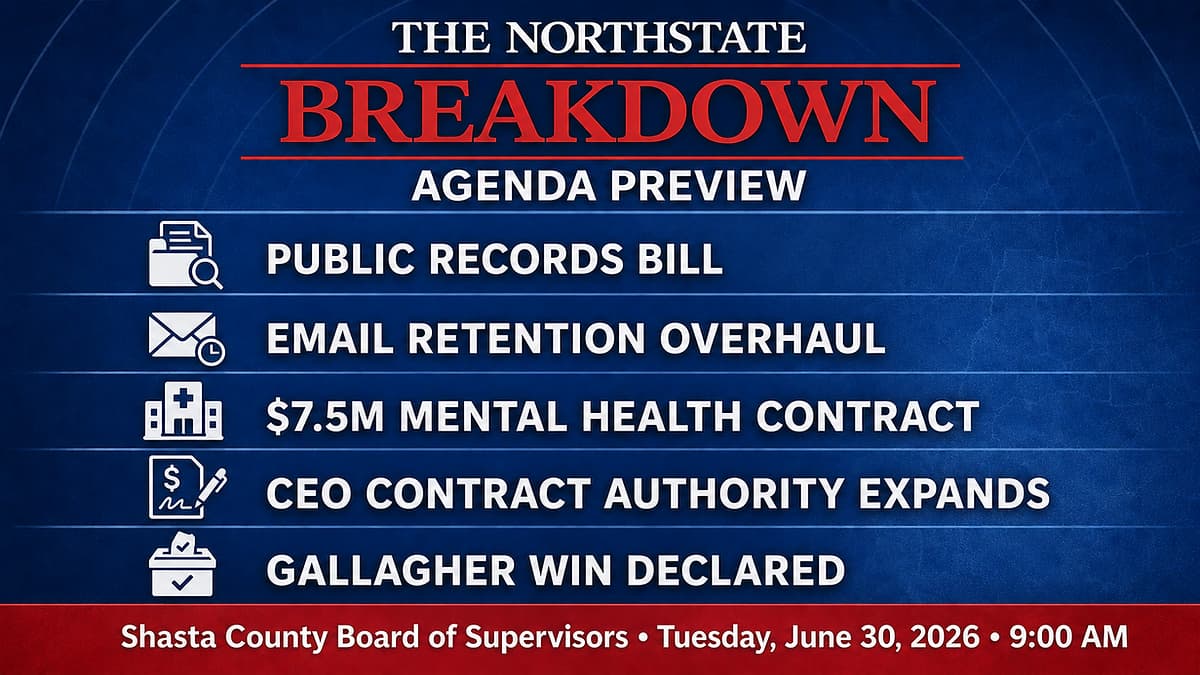
REDDING — The Shasta County Board of Supervisors will weigh two measures Tuesday that bear on how the public gets government records and how long the county keeps them: a letter of support for a contested state bill that would let agencies charge some requesters for the cost of searching records and ask a judge to shut down requests it deems "malicious," and a rewrite of county policy that would automatically delete county emails not kept as official records after one year. The board will also renew a three-year, $7.5 million contract for locked, out-of-county residential mental-health beds — the largest dollar item of the day.
Separately, the board will formally declare James Gallagher's June 2 election to Congress, even as the agenda is silent on the county's own results from that day — contests in which Supervisor Kevin Crye and the appointed registrar of voters each appear, on the latest unofficial returns, to have lost their seats. Filling out the agenda are an expansion of the chief executive's power to sign contracts without a board vote, a coalition letter urging Sacramento to limit lawsuits against public agencies as the county defends several of its own employees' suits, a General Fund budget increase for an agriculture building running ahead of schedule, the county's Proposition 1 behavioral-health plan due to the state that same day, two public hearings and a closed-session lawsuit in which Shasta County is a named defendant. Here is a look at the major items on the agenda.
SUPERVISORS WILL DECLARE GALLAGHER'S CONGRESSIONAL WIN — BUT NOT THE COUNTY'S OWN RESULTS (R2)
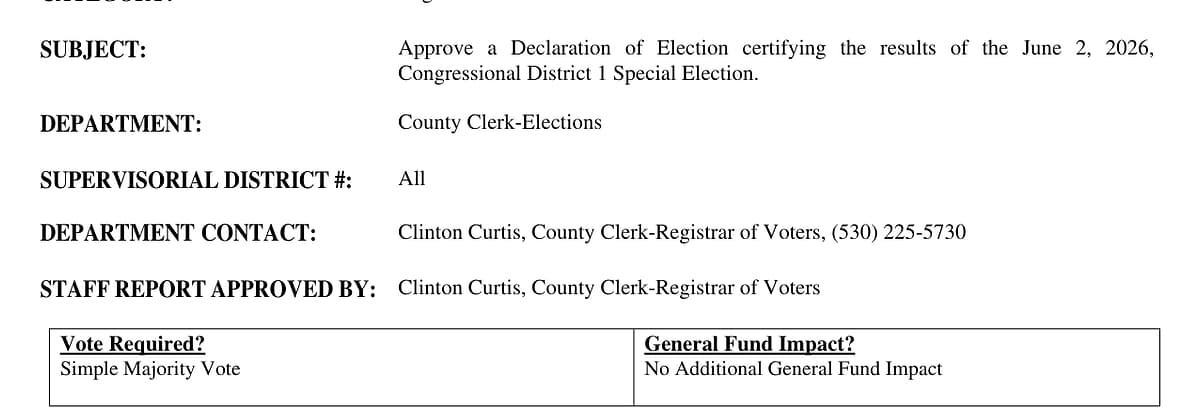
The board's only election item is a Declaration of Election certifying the June 2 result of the Congressional District 1 special election, formally declaring Republican James Gallagher elected to fill the seat left vacant by Rep. Doug LaMalfa's death. The step is ministerial: the county clerk and registrar of voters has already delivered the certified statement of results, and under Elections Code Section 15372 the board is required to receive and declare it — the staff report lists "no recommended alternatives." The item is brought by County Clerk-Registrar Clinton Curtis.
That same June 2 ballot also carried the county's own regular primary — including the District 1 supervisor seat held by Kevin Crye and the registrar of voters office Curtis himself was appointed to in 2025 — but no item on Tuesday's agenda addresses those races. On the latest unofficial returns, both incumbents lost: Crye was defeated by Redding City Council member Erin Resner, who cleared the majority needed to win outright in the primary with no November runoff, and Curtis lost the registrar's race to Joanna Francescut, the county's longtime assistant registrar of voters.
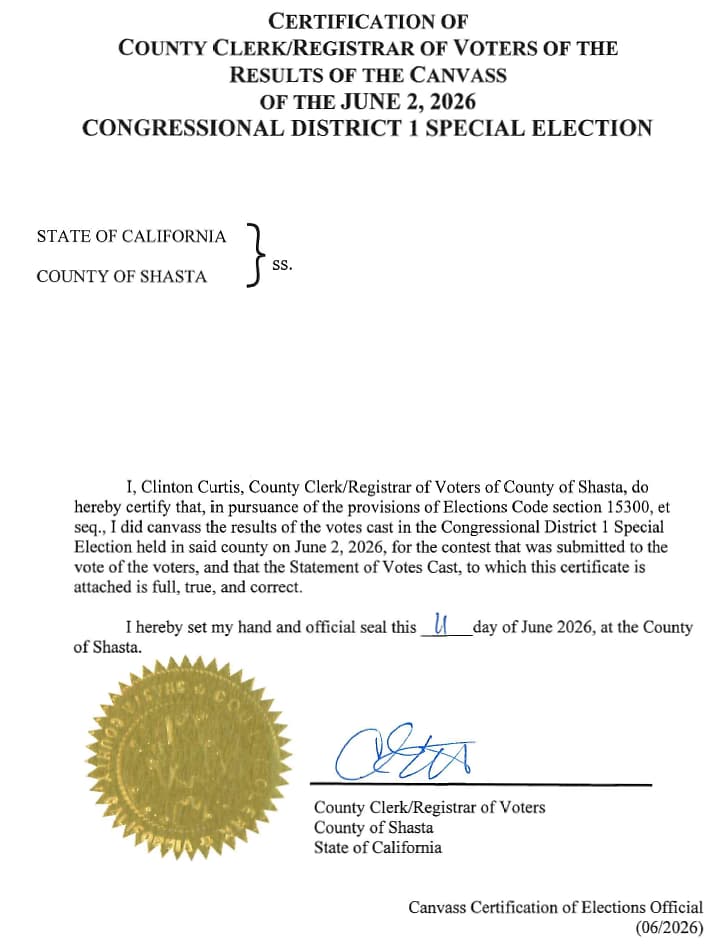
The difference is one of timing, not choice. The special election was certified and sent to the board because Gallagher won outright and must be seated quickly; the regular primary results remain on the 30-day certification clock — official certification is due in early July — and the local winners do not take office until 2027, so any board action on those races would come at a later meeting.
CEO DELIVERS UPDATE AND LEGISLATIVE PLATFORM (R3)
County Executive Officer David Rickert presents a general county update and may seek board action on specific legislation tied to the county's legislative platform, followed by supervisors' reports. There is no vote on the update itself, but the county's Sacramento priorities surface elsewhere on Tuesday's agenda: the board is separately asked to support a state public-records bill (R5) and to lend the county's name to a coalition pressing the Legislature to limit lawsuits against public agencies (C2).
CONSENT CALENDAR HIGHLIGHTS
The 20-item consent calendar is approved in a single vote unless a supervisor or member of the public pulls an item for discussion. The largest dollar figures and the items of broadest public interest:
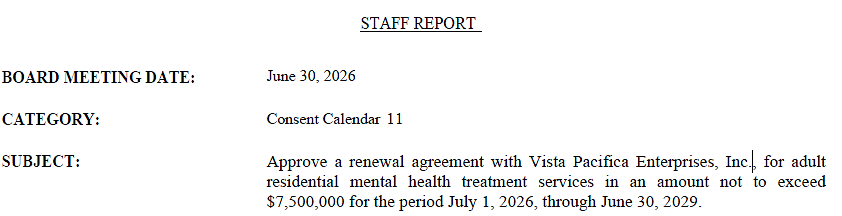
C11 — Vista Pacifica mental-health contract renewed at $7.5 million over three years: The board would renew a personal-services agreement with Vista Pacifica Enterprises Inc., a Riverside-area residential facility, at a not-to-exceed $7.5 million for fiscal years 2026 through 2029 — the single largest contract on the agenda, riding the consent calendar. The vendor provides round-the-clock, long-term residential treatment for adults with severe and persistent mental illness as "an alternative to placement in an acute inpatient care setting or a state hospital," according to the staff report, and is paid through state realignment dollars in the county's mental-health budget with, staff stress, no additional General Fund cost and no county match. The county "has contracted with Vista Pacifica for the last several years," the report notes; if the agreement were denied, clients "may be redirected to less desirable out-of-county providers, if any are available." The facility is a secure, 108-bed skilled-nursing center on the state Department of Health Care Services' list of Institutions for Mental Disease. The renewal continues at the same ceiling the board last approved unanimously on Dec. 19, 2023, when the prior three-year agreement also carried a $7.5 million cap. It is the kind of high-dollar outside contract drawing fresh scrutiny: the North State Breakdown reported June 16 on a proposed 18 percent administrative-cost cap on the county's nonprofit contractors, and Shasta Scout reported June 26 that some supervisors want to limit the county's nonprofit contracts.
C18 — $525,000 General Fund commitment as agriculture-building project outpaces its budget (4/5 vote): Public Works asks the board to approve a set of budget amendments for the "Ag Remodel & Building Addition (ARBA) – 1265 Redwood Blvd." project in District 2 after construction progressed faster than anticipated and the contractor came in, in the staff report's words, "a week ahead of schedule." The amendments raise appropriations across four budget units — $525,000 in the Agricultural Commissioner's budget, $350,000 in roads, $175,000 for land and buildings, and $525,000 in the Accumulated Capital Outlay budget offset by the General Purpose Assigned Fund Balance — making it the only item on the agenda carrying a General Fund impact and one of two requiring a four-fifths supermajority. Staff say future utility-users'-tax revenue is expected to reduce General Fund requests in later years. The board approved a prior amendment for the same project June 16, and the project has been on its radar since June 5, 2024.
C9 — County adopts its Proposition 1 behavioral-health plan on the state's deadline day: The board would approve the county's Behavioral Health Services Act Integrated Plan for fiscal years 2026 through 2029, the local blueprint required under Proposition 1, the March 2024 ballot measure that overhauled the 2004 Mental Health Services Act. Counties' final, board-approved integrated plans are due to the state Department of Health Care Services by June 30 — so Shasta's adoption falls on the statewide deadline, the same step all 58 counties face. The county's transition from the old act to the new one has been on the record since an Aug. 20, 2024 board briefing; Shasta Scout covered the plan's public-input process July 30, 2025.
C1 and C4 — CAL FIRE wildfire money: The board would ratify the chief executive's signature on an amendment adding $290,000 to a greenhouse-gas-reduction grant from CAL FIRE, raising the agreement's ceiling to $1,289,036.48 from $999,036.48; the original award was ratified July 16, 2025, when the board was not in session. A companion item, sponsored by Supervisor Matt Plummer, adds the county's support to the Western Shasta Resource Conservation District's application for a CAL FIRE wildfire-prevention grant for a defensible-space readiness program. Neither carries a General Fund cost.
C2 — County asked to back a Sacramento push to limit lawsuits against public agencies — while defending several of its own: The board would add Shasta County's name to a June 5 letter from the California Association of Joint Powers Authorities urging the Legislature to make it harder to sue public entities — seeking caps on damages, proportional liability for economic damages and tougher evidentiary standards. The letter argues public-entity liability costs have tripled in seven years to more than $7 billion in statewide exposure, projects a further 70 percent increase by 2027-28, and points to the 2019 law reviving old childhood-sexual-assault claims, Assembly Bill 218, as "one stark driver." It is a general advocacy letter, not support for a single named bill.

The request lands as Shasta County is itself defending a cluster of suits from former and current employees who say it retaliated against them. Former assistant county executive officer and ex-Sheriff Eric Magrini sued in 2026 (Shasta County Superior Court case 25CV-0208798) after a wrongful-termination claim that names Supervisor Kevin Crye; former senior deputy county counsel Alan Cox sued in May (case 210602), alleging he was punished for refusing to make improper court filings; and Joanna Francescut — the county's assistant registrar of voters, who went on to win the June 2 election for registrar — filed a discrimination, harassment and whistleblower-retaliation suit on May 19 (case 26CV-0210702) while still working in the elections office. All three remain pending, and the allegations have not been tested in court. (Sources: Shasta County Superior Court filings; Record Searchlight and Shasta Scout reporting; prior North State Breakdown research.)
C3 — County formally opposes a Caltrans roundabout on Highway 44: A letter sponsored by Chair Chris Kelstrom would register the county's opposition to Caltrans District 2's proposed single-lane roundabout at the Highway 44 intersection with Silver Bridge Road, in Districts 3 and 5. Caltrans counted nine collisions there over the five years ending in April 2025, one of them fatal and seven causing injury, according to the letter. The board's counterargument is to wait: it wants three to five years of data on whether the reduction of the speed limit there to 55 mph from 65 — which Caltrans imposed Jan. 14 — improves safety on its own, or to consider cheaper alternatives such as a restricted-crossing design or longer merging lanes. Supervisor Corkey Harmon raised the roundabout at the June 10 budget hearing; the item has not otherwise drawn organized public opposition.
C8 — $300,000 added to Alcohol and Drug Programs: A budget amendment would add $300,000 in appropriations to the county's Alcohol and Drug Programs budget, offset by a restricted fund balance with no General Fund impact; it is the second item requiring a four-fifths vote.
C20 — One-year extension for the jail commissary vendor: The board would extend its commissary contract with Keefe Commissary Network LLC by one year, to June 30, 2027, with no change in price, while the two sides negotiate a longer renewal. Commissary revenue flows to the county's Inmate Welfare Fund, which can be spent only on the benefit, education and welfare of inmates under Penal Code Section 4025. Keefe, part of TKC Holdings and owned by the private-equity firm H.I.G. Capital, has drawn national criticism over the prices it charges incarcerated people, reported by outlets including THE CITY and the Santa Fe New Mexican.
The remaining renewals on the consent calendar are routine continuations of existing services, together totaling roughly $1.4 million in not-to-exceed spending: administrative-hearing officers (C5, $185,000), Form 700 e-filing through NetFile (C6, $92,820), CalMHSA psychiatric inpatient review (C7, $268,464), Northern Valley Catholic Social Services assessments (C10, $60,000), SafeMeasures child-welfare data from Evident Change (C12, $163,161), mental-health case management and substance-use counseling through Shasta Community Health Center (C13, $285,550), learning-disability evaluations by Brain Learning Psychological Corp. (C15, $252,000), and public-health software from Netsmart (C17, $68,953.22), along with a maternal-and-child program through Nurse-Family Partnership (C16), a Medi-Cal inmate-program reimbursement agreement with the state (C19, $15,790.52), and a retroactive revenue amendment with the County Medical Services Program (C14) that carries no county cost.
MANUAL OVERHAUL WOULD AUTO-DELETE NON-RECORD EMAILS AND EXPAND THE CEO'S SPENDING DISCRETION (R4)
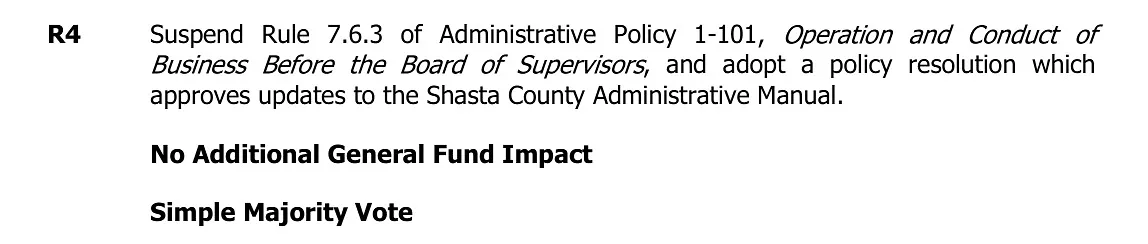
The board will adopt a wholesale update to the Shasta County Administrative Manual, brought by the County Administrative Office, that — among dozens of revisions — establishes a countywide timeline for automatically deleting electronic messages where its predecessor policy set none. The resolution repeals the county's 2011 email policy and replaces it with a new Electronic Message Retention Policy, Policy 4-400, which the staff report says "expands the definitions of electronic messages and defines a Countywide retention policy for those messages." It needs a simple majority and carries no General Fund cost; the board would first suspend its own Rule 7.6.3 to act in a single sitting.
Under the new policy, emails "not classified as official records may be retained for up to 365 days and automatically deleted thereafter," while text messages, group chats, collaboration-tool messages and direct messages "shall be retained for a period not to exceed 90 days and then automatically deleted." A separate provision states that "messaging platforms shall not be used to avoid records retention requirements." Emails and messages that qualify as official records are exempted and must still be kept under the county's Records Retention Schedule.
The change adds an automatic deletion clock where the prior policy had none. The 2011 policy it replaces, Administrative Policy 3-401, set email retention "by the content of the message, not the medium," told employees that non-vital messages "should be discarded routinely" and that they bore "the same responsibilities for their mailbox messages as they do for any other public record" — but it fixed no expiration date for ordinary email and ordered no automatic purge, leaving non-record messages to sit until an employee deleted them. County staff describe the broader manual rewrite as overdue housekeeping: "many policies have not been updated in several years," the report says, prompting a review of the entire manual.
The same resolution also expands the county executive officer's power to commit public money without a board vote. It raises the informal purchase-order limit to $5,000 from $3,000 and, more consequentially, lifts the ceiling on the services contracts the executive can sign as the county's purchasing agent to the maximum allowed under state law — $80,000 beginning July 1, up from the $50,000 the county now uses — with that limit set to rise automatically with inflation each year after. The change also lets the executive sign revenue agreements of up to $750,000 and certain no-cost agreements without coming to the board.
How much that discretion can matter was on display last year. The board never voted to approve the county's roughly $40,000 healthcare-consulting contract with Chriss Street, the former Orange County treasurer-tax collector brought in to study a proposed medical school and residency program championed by Supervisor Kevin Crye. On Feb. 4, 2025, the board voted 4-1 — with Supervisor Allen Long opposed — only to authorize County Executive Officer David Rickert to draft and sign a consultant contract; Rickert, who had recommended Street, then signed the personal-services agreement himself later that month, and the spending never returned to the board for approval. The no-bid arrangement drew a taxpayer lawsuit from retired public defender Jeff Gorder, who named the county, the board and Rickert and alleged it sidestepped the county's own procurement rules; a judge declined to halt the contract in June 2025. Under the higher $80,000 ceiling, the executive could sign services contracts of that size without even the one-item delegation vote the Street deal required.
The records-retention vote is one of two transparency-related actions on Tuesday's agenda. The other is the board's separate decision, taken up next, on whether to support a state bill that would restrict public access to records.
BOARD WEIGHS SUPPORT FOR A PUBLIC-RECORDS BILL THE STATE'S PRESS IS FIGHTING (R5)
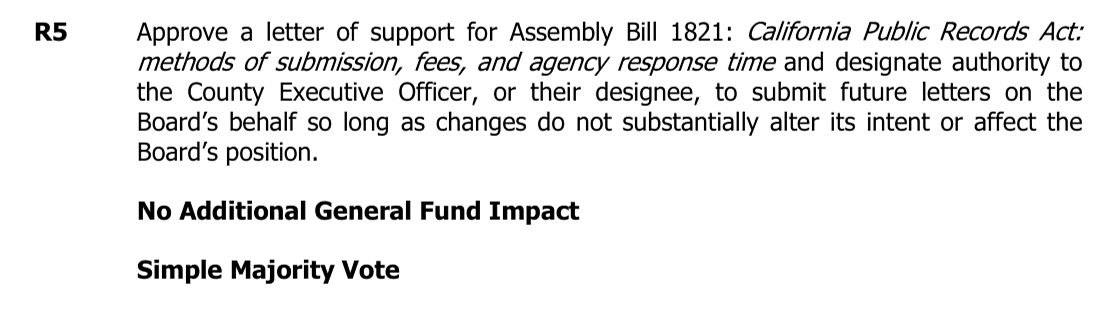
The second records item asks the board to approve a letter supporting Assembly Bill 1821, a rewrite of the California Public Records Act, and to authorize the chief executive to send follow-up letters on the board's behalf. Brought by the Clerk of the Board, it needs a simple majority — but it would put the county on record backing a bill that much of California's news and open-government establishment is fighting, and that the county's own lobbying associations in Sacramento are sponsoring.
As amended in the state Senate on June 25, the latest version in print, the bill would make several changes at once. It would let an agency charge a requester for staff "search and review time" when it determines a request is for a "commercial use," at an administrative rate of $22.35 an hour and a professional rate of $66.26 an hour, while exempting requests from educational and noncommercial scientific institutions, government agencies and "a representative of the news media." It would let an agency "petition the superior court for a determination that a requester submitted a request with malicious intent, including for the purpose of delaying the agency"; if a judge agrees, the agency could bill the requester for search and review time and suspend its duty to respond. It would change an agency's deadline to determine whether it holds disclosable records from 10 calendar days to 10 business days, extendable by up to 14 business days. And it would require agencies to designate a physical office and an email address for requests, deeming anything submitted another way "not properly requested."
Current law sets a lower bar on both fronts: Government Code Section 7922.535 gives an agency 10 calendar days to make that determination, and Section 7922.530 limits what it can charge to the "direct costs of duplication" — copying alone, with no charge for staff time and no distinction between commercial and ordinary requesters.
The county has a documented stake in the volume of requests. Its own figures show Public Records Act requests climbing from 265 in 2023 to 518 in 2024 and 1,321 in 2025, with more than 1,200 logged through mid-June of this year, according to the staff report; County Executive Officer David Rickert briefed the board on the same surge April 7, citing roughly 1,316 requests in 2025 from about 670 requesters. The bill is sponsored by the League of California Cities and the California State Association of Counties — the latter an organization Shasta County belongs to and pays to advocate on its behalf.
Lined up against it is much of California's press and open-government community, including the California News Publishers Association, the First Amendment Coalition, the ACLU of California and the Howard Jarvis Taxpayers Association. First Amendment Coalition Executive Director David Snyder has said the court-petition power "would be easily weaponized by agencies seeking to thwart transparency," and University of Florida professor David Cuillier has said the bill would make California "the most secretive state in the country," according to CalMatters and the coalition. Two local outlets raised alarms days before the vote — the Record Searchlight on June 17 and Shasta Scout on June 19, which called the measure "of special interest in Shasta," the county whose board is now poised to support it.
The bill passed the Assembly 55-12 on May 27 and sits in the Senate Judiciary Committee. Its author, Assemblymember Blanca Pacheco, D-Downey, has signaled she intends to scale the measure back toward its original, narrower form, the Los Angeles Times reported June 25, but as of the June 25 amendments the fee and "malicious requester" provisions remained in the bill's text.
PUBLIC HEARING: SISKIYOU TRASH CHARGE FOR THE CASTLE ROCK AREA (R6)
The board holds a public hearing to continue, for the 2026-27 fiscal year, a $72.45-per-parcel annual charge on residential properties in the Castle Rock area of northern Shasta County, whose household trash is hauled to and disposed of in neighboring Siskiyou County under a 1987 agreement. The charge, collected on the property-tax roll, is set 15 percent above Siskiyou County's own $63 rate, and the proceeds are forwarded to Siskiyou County, which disposes of the waste; Shasta budgets its administration costs separately. The hearing was noticed in the Record Searchlight and the Mount Shasta Herald. It is a long-running cross-county arrangement, not a new fee.
PUBLIC HEARING: ZONE CHANGE NEAR OLD OREGON TRAIL (R7)
The board holds a second public hearing on Zone Amendment 26-0001, a technical fix tied to a property on Old Oregon Trail north of Redding. Acting on Planning Commission recommendations and finding the action exempt from the California Environmental Quality Act, the board would enact an ordinance amending an earlier ordinance to extend the timeframe for the applicant, the Johnson Family Trust, to pay the county and Fish and Wildlife filing fees for a notice of exemption — the last step before a previously approved zoning change on a four-acre portion of an 88.9-acre parcel can take effect alongside a recorded property-line adjustment. It needs a simple majority.
CLOSED SESSION: COUNTY IS A NAMED DEFENDANT IN A MOBILE-HOME-PARK INJURY SUIT (R8)
The board recesses to closed session for one item of existing litigation under Government Code Section 54956.9(d)(1): Denise Eye v. Fairway Oaks Mobile Home Park et al., Shasta County Superior Court case No. 208669, estimated at 10 minutes. Court records list the matter under the case number 25CV-0208669, filed Sept. 11, 2025, as an unlimited civil action for personal injury, property damage or wrongful death assigned to Judge Ryan H. Birss, and show it remains active, with an order to show cause regarding sanctions set for July 13. The named defendants are the privately operated 55-and-older park in south Redding, the city of Redding and Shasta County; the complaint's specific allegations against the county are not detailed in the public docket. The board last discussed Fairway Oaks in an unrelated context, a Sept. 27, 2022 hearing on the park's water system. The litigation has not been previously reported.
OTHER AGENCIES
As is routine, the supervisors will recess and reconvene as the governing board of the In-Home Supportive Services Public Authority to handle that body's business, with no additional compensation.
And that's the agenda preview.