

Shasta County Supervisors Meet Today — Budget Hearings Begin, Board Weighs AI Policy and ADU Overhaul, $6 Million Private-Prison Contract Up for Renewal
 By Benjamin Nowain•June 8, 2026•7 min read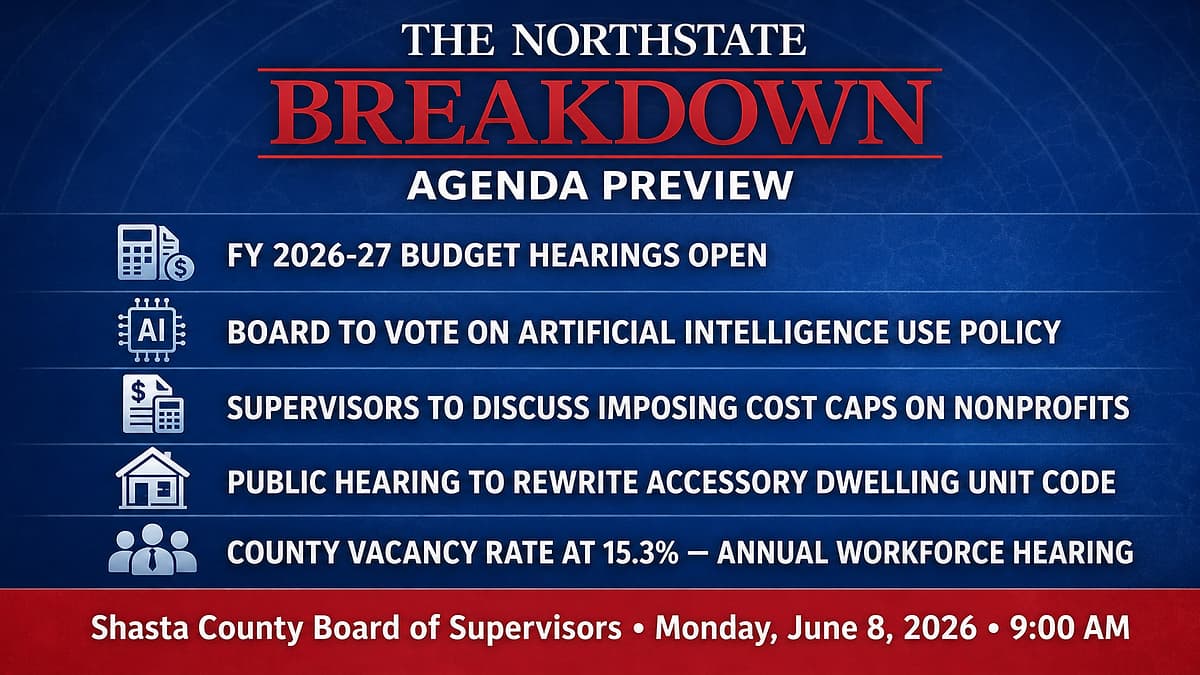
The Shasta County Board of Supervisors meets Monday with one of its most consequential agendas of the year: the formal opening of FY 2026-27 budget hearings that will run into next week, a vote on a first-of-its-kind artificial intelligence use policy, and a public hearing to rewrite the county's accessory dwelling unit code. The board will also consider a five-year, $6.2 million renewal with GEO Reentry Services — a subsidiary of one of the largest private prison and detention operators in the United States — for the county's Day Reporting Center, and take up a discussion about imposing administrative cost caps on nonprofits that receive county funding.
Here is a look at the major items on the agenda.
BOARD TO VOTE ON ARTIFICIAL INTELLIGENCE USE POLICY (R4)
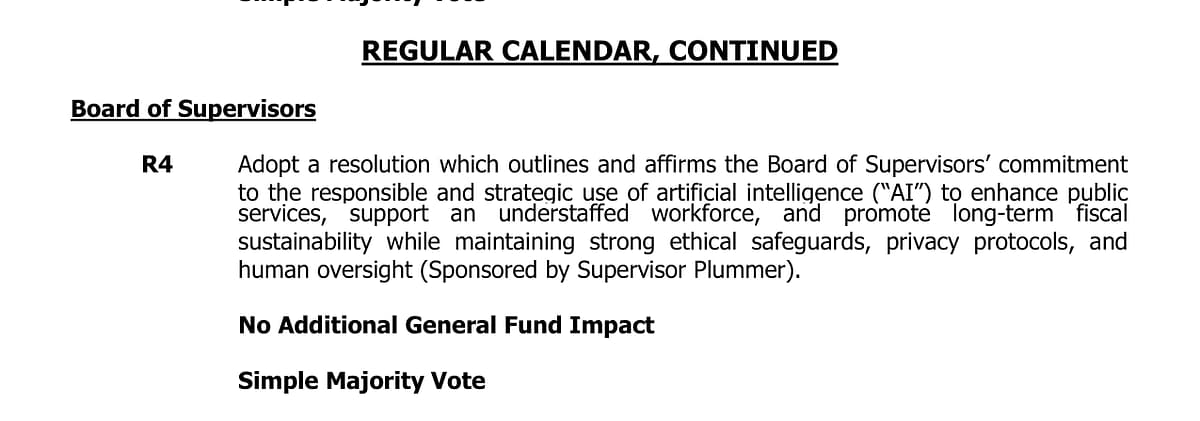
Supervisors will consider adopting a resolution affirming the county's commitment to "the responsible and strategic use of artificial intelligence to enhance public services, support an understaffed workforce, and promote long-term fiscal sustainability while maintaining strong ethical safeguards, privacy protocols, and human oversight." The item is sponsored by Supervisor Matt Plummer.
A formal AI use policy is uncommon at the level of a rural county. The resolution would establish the board's official position on how AI may be deployed in county operations — a framework-setting step that typically precedes departmental pilot programs or vendor procurement. The full resolution text is available in the meeting packet.
SUPERVISORS TO DISCUSS IMPOSING COST CAPS ON NONPROFITS (R5)
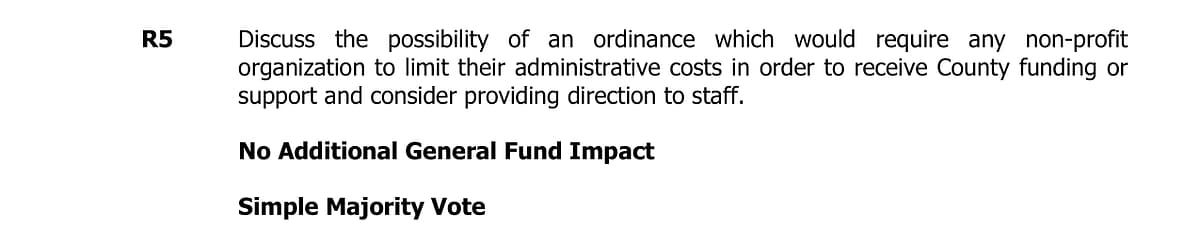
The board will discuss whether to direct staff to draft an ordinance capping administrative costs at 10% of total revenue as a condition for any nonprofit to receive county funding or support. The proposal was brought back at board direction from the May 19 meeting. Monday's item is a discussion only — no ordinance is before the board — but the direction supervisors give will determine whether drafting proceeds.
The discussion arrives with a clear political backdrop. Supervisor Kevin Crye has been among the most vocal critics of nonprofit overhead costs in public settings, making it a recurring theme in board proceedings and the 2026 election cycle. Crye has publicly questioned the administrative record of Children's Legacy Center — a Redding nonprofit that grew from $1.6 million in revenue in 2021 to $12.7 million in 2023 and was the second-largest recipient of Zogg Fire PG&E criminal settlement funds distributed by the Shasta County District Attorney, with the organization's CEO compensation rising from approximately $19,200 in 2018 to $221,124 by 2023.
More recently, Crye — who sits on the board of Youth Options Shasta, a county-funded Redding youth nonprofit — filed a police report in September 2024 against the organization's then-executive director, Susan Wilson, alleging she had given herself unauthorized pay increases totaling roughly $37,000 over three years. Wilson was fired in September 2024 and has denied wrongdoing. At the May 5, 2026 Board of Supervisors meeting, Crye held up a copy of the police report and said, "I have a really hard time with people who steal. I have a harder time when they steal from children."
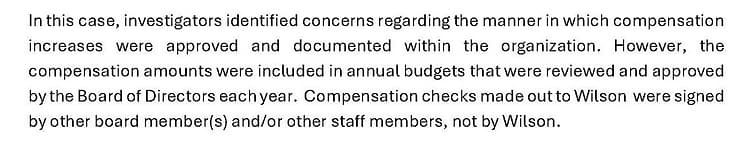
Both the Anderson Police Department and the Shasta County District Attorney's office subsequently declined to file charges. APD's investigation found that the salary increases for Wilson and other employees were approved by the nonprofit's board and reflected in annual budgets, and that all checks were signed by other board members, not Wilson. DA Stephanie Bridgett denied any political dimension to the decision: "Allegations that decisions in this case…were influenced by political relationships, personal friendships, or community status are offensive, unprofessional and inaccurate." Crye has disputed the agencies' conclusions. Wilson is now president of the League of Women Voters of Shasta County.

Shasta County contracts with numerous nonprofits across health, social services, housing, and justice-adjacent programs. A 10% administrative cost ceiling would require organizations receiving county dollars to demonstrate compliance with the standard as a condition of continued funding. Critics of such caps argue they disfavor larger, more complex service providers whose overhead is proportionally higher, and can push cuts to organizational capacity rather than to program delivery.
PUBLIC HEARING TO REWRITE ACCESSORY DWELLING UNIT CODE (R6)
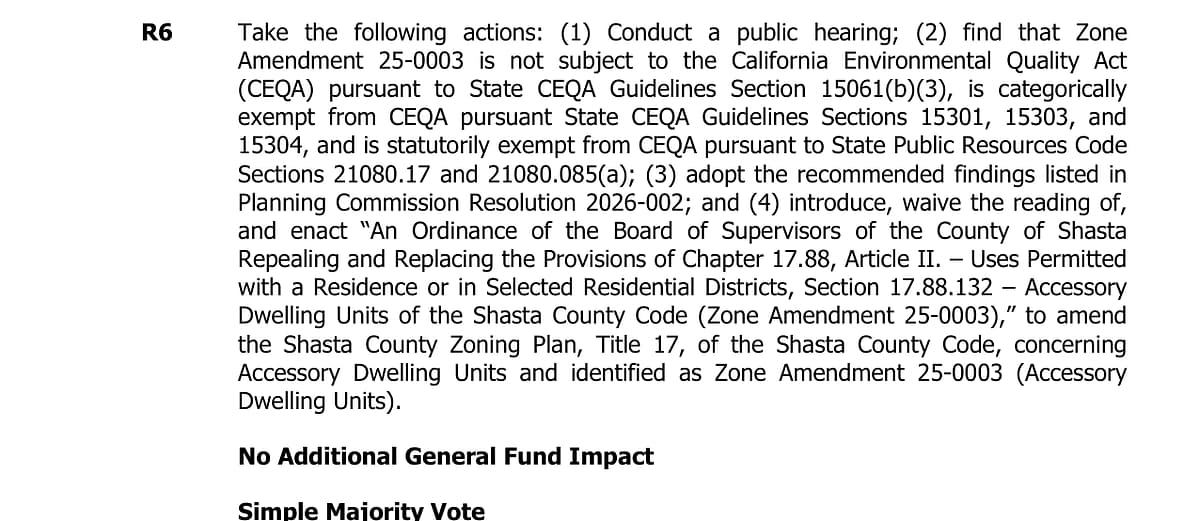
The board will hold a public hearing and consider enacting an ordinance that repeals and replaces Section 17.88.132 of the Shasta County Zoning Code — the provision governing accessory dwelling units — with updated language under Zone Amendment 25-0003.
The rewrite is based on Planning Commission Resolution 2026-002 and is categorically and statutorily exempt from California Environmental Quality Act review under multiple state law provisions, including Public Resources Code Sections 21080.17 and 21080.085(a), which specifically exempt local ADU ordinances from environmental review. The updated code is intended to bring county ADU regulations into alignment with evolving state requirements on secondary residential units.
Public comment is limited to issues raised at the hearing or submitted in writing beforehand. Any legal challenge to board action on the item would be limited to those same issues under state law.
COUNTY VACANCY RATE AT 15.3% — ANNUAL WORKFORCE HEARING (R7)
The board will hold a mandatory public hearing on the county's vacancy, recruitment, and retention data — required annually under AB 2561, which took effect January 1, 2025, and added Section 3502.3 to the Government Code. The presentation, prepared by the Support Services Department, must occur before final budget adoption each year.
As of May 2, 2026, the county's overall vacancy rate stands at 15.3%, down from a high of 18.1% in 2023 but essentially flat since 2024. Several bargaining units remain under significant staffing pressure. The Teamsters Deputy Coroner Investigators unit carries a 25% vacancy rate, which triggers a legal requirement for the county to provide additional disclosure data on applicant counts, average hiring timelines, and compensation. The UPEC General Unit and UPEC Professional Unit — the county's two largest employee groups — sit at 19.0% and 19.4% vacancy respectively, and the Deputy Sheriffs, Sergeants, and DA Investigators unit (DSA) stands at 13.8%.
The county ran 464 recruitments in 2025 and made 677 conditional offers — a sharp increase from prior years. No vote is required; the hearing is informational and is legally required to be held in open session before the board.
FY 2026-27 BUDGET HEARINGS OPEN — APPEALS FILED FOR THREE DEPARTMENTS (R8)
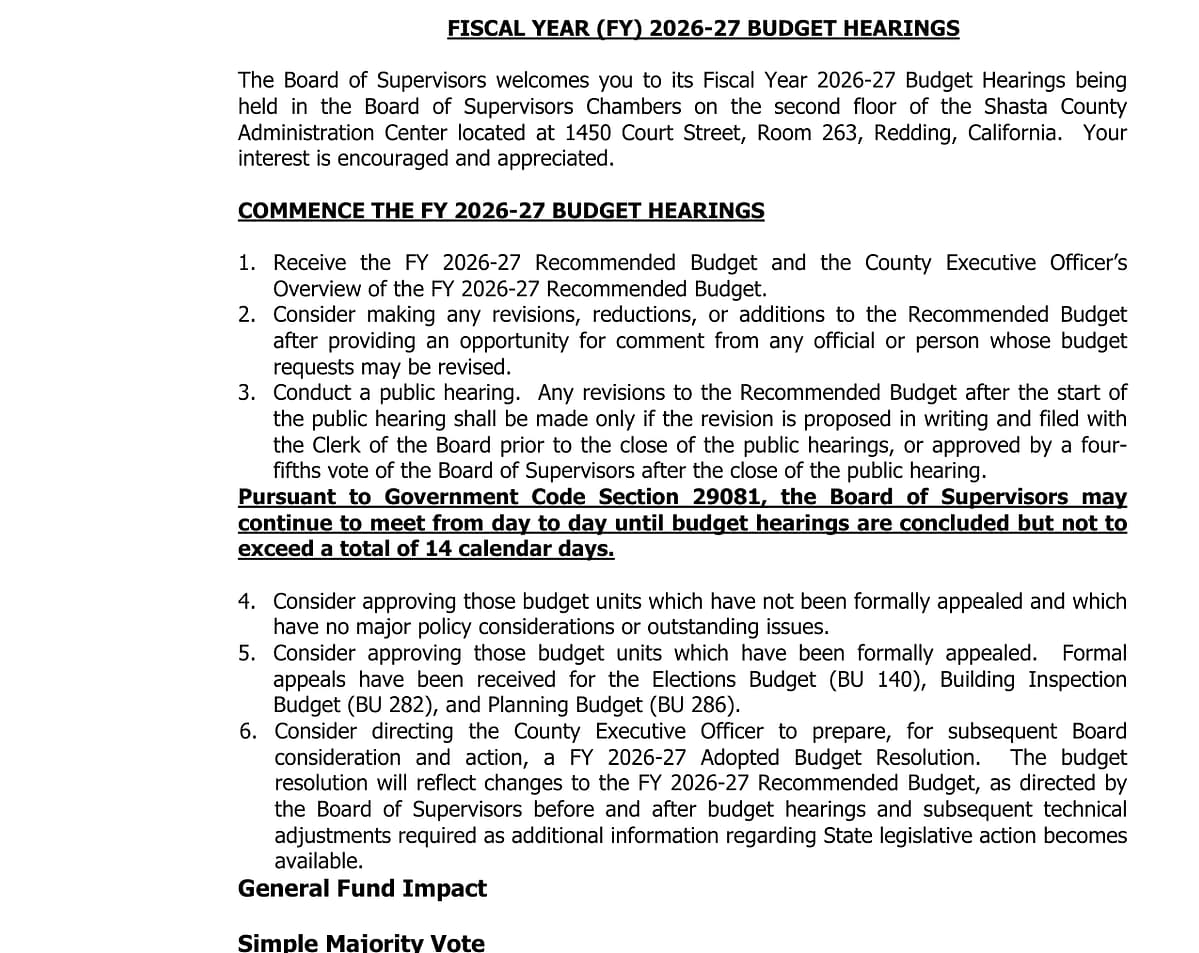
Monday's meeting sets the clock running on the county's annual budget process. The board will formally receive the FY 2026-27 Recommended Budget and the County Executive Officer's overview, then open a public hearing period that continues starting Tuesday, June 9, at 9 a.m. and may run up to 14 calendar days.
This year's hearings arrive with formal budget appeals already on file for three departments: Elections (Budget Unit 140), Building Inspection (Budget Unit 282), and Planning (Budget Unit 286). Under the hearing structure, supervisors will first take up budget units with no appeals and no major policy issues, then address the appealed units in a separate session. After hearings conclude, the CEO will prepare a FY 2026-27 Adopted Budget Resolution incorporating any board-directed revisions and subsequent technical adjustments as state legislative action becomes clearer.
The county's overall appropriations limit for FY 2026-27 is set at $323,409,861 under a separate consent item (C6).
CONSENT CALENDAR HIGHLIGHTS
The following items appear on the consent calendar and are scheduled for approval without discussion unless a supervisor requests otherwise.
$6.2 MILLION DAY REPORTING CENTER RENEWAL WITH GEO REENTRY SERVICES (C17)

The board will consider renewing the county's agreement with GEO Reentry Services, LLC for operation of Shasta County's Day Reporting Center for five years — July 1, 2026 through June 30, 2031 — in an amount not to exceed $6,194,524.
GEO Reentry Services is a subsidiary of The GEO Group, Inc., one of the largest private prison and detention management companies in the United States, The Day Reporting Center is a community supervision program serving individuals on probation or parole as an alternative to incarceration.
The consent calendar placement means no public discussion is scheduled unless a supervisor pulls the item. Public records on prior contract performance and DRC outcomes are available through a Public Records Act request to the county.
MOTOROLA COMMUNICATIONS CONTRACT TERMINATED (C23)

Supervisors will consider approving an agreement with Motorola Systems, Inc. that terminates the county's existing communication system and services contract with the company. No replacement arrangement is identified on Monday's agenda.
MENTAL HEALTH AND SUBSTANCE USE FUNDING (C12–C14)
Three behavioral health funding items are on the consent calendar. The board will consider approving the Mental Health Services Act Annual Update and Expenditure Plan for FY 2025-26 (C12); accepting a $1,297,074 Community Mental Health Services Block Grant (C13); and approving an application for $2,189,824 in Substance Use Prevention and Treatment Block Grant funding through the state (C14). All three items carry no additional General Fund impact.
CLOSED SESSION
Supervisors will convene in closed session to discuss two existing lawsuits: Yuzon v. County of Shasta (Case No. 207728) and J.A. v. County of Shasta (Case No. 24CV-0204180). The board will also take up one matter of anticipated litigation under Government Code Section 54956.9(d)(2). Any reportable action will be announced following the closed session.