

Opioid Money, Familiar Faces: Tuesday July 28th 2026 Shasta County Agenda
 By Benjamin Nowain•July 27, 2026•8 min read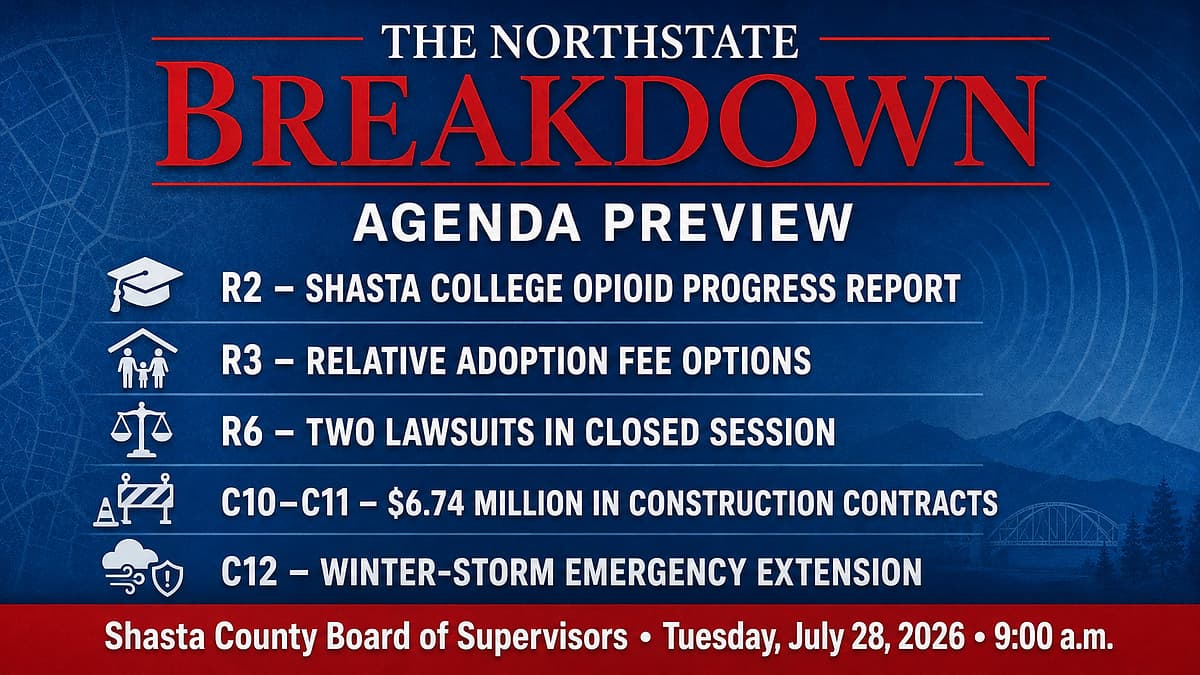
The Shasta County Board of Supervisors meets Tuesday, July 28, for what looks, on paper, like a quiet summer session, three presentations with no votes, two routine tax-roll hearings, a two-case closed session, and a consent calendar of grant acceptances. But one of those no-vote presentations sits on top of the county's opioid-settlement spending, more than $10 million committed so far, out of a settlement projected to reach nearly $40 million, and that spending includes $4 million steered to two nonprofits run by the very committee members who recommended the money. Meanwhile, the nonprofit-accountability policy this same board promised to deliver "in July" is on neither of July's agendas.
The Hook: A Progress Report on Opioid-Funded College Seats
Item R2 is a presentation from Shasta College, Dean of Student Services Sandra Hamilton and Career Services Director Jenny Beckman, speaking on two programs paid for with $888,683 in opioid-settlement money: STEP-UP, a pathway that helps formerly incarcerated and recovering students earn certificates and degrees, and the college's Alcohol and Drug Studies program, which includes a paid-internship component. It is a required progress report, not a request for new money. There is nothing to vote on.

But the money behind it has a history. The board approved the Shasta College funding on December 16, 2025, on a 4-1 vote — Kelstrom moving, Crye seconding, and Plummer casting the lone "no." Plummer argued the drug-studies program "was functioning adequately with current funding" and objected specifically to subsidizing the internship stipend. The board then formalized the arrangement as a retroactive three-year agreement, 5-0, on June 8, 2026. R2 is the first of the required check-ins on how that money is being spent, a routine item that happens to open a window onto everything else the county has done with its opioid settlement.
Dec. 16, 2025 — the board funds the Shasta College program on a 4-1 vote, Supervisor Plummer opposed.
Where the Opioid Money Actually Went
In response to a public-records request, the county released its own "Committed Funds" schedule earlier this year: $10,107,467 obligated so far, out of a settlement projected to total roughly $38 to $39 million through the 2038-39 fiscal year. The single largest line is not the college. It is $3 million to Raising Shasta and $1 million to Youth Options Shasta — $4 million, to two organizations, approved together.
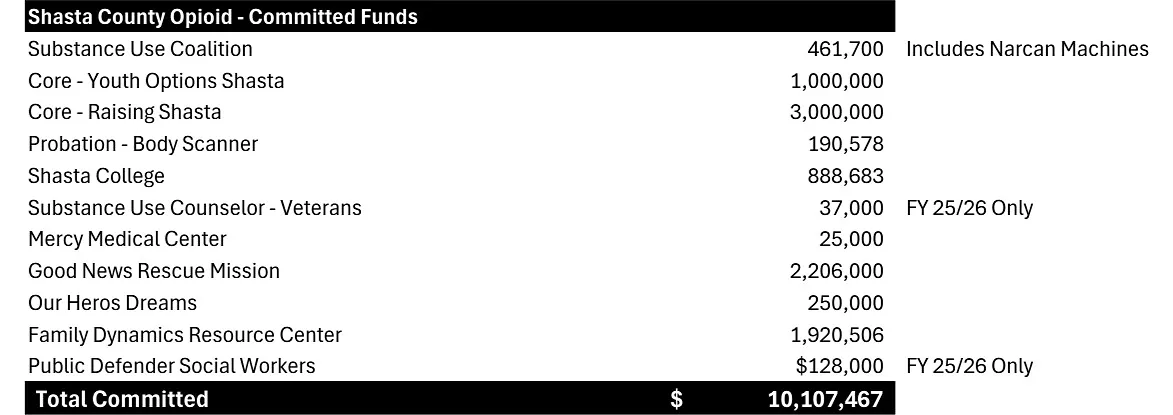
Those two grants were recommended by the county's CORE committee, a four-member advisory group set up to steer youth-prevention dollars. Two of its four members are the executive directors of the exact two nonprofits that received the entire $4 million: Jenna Coulter, who runs Youth Options Shasta, and Jenna Berry, who runs Raising Shasta. Crye — the previous board chairman who had championed the youth-prevention priority — sat on Youth Options' board at the time it was selected, before leaving it later.
And the way the $4 million cleared the board is its own detail. It was not debated. On May 27, 2025, the two contracts rode through on the consent calendar — the block of items adopted in a single motion, without discussion — carried 5-0.
Interestingly, neither "Raising Shasta" nor "Youth Options Shasta" files a tax return under that name; each is a "doing-business-as" operating under a parent nonprofit — the Shasta County Child Abuse Prevention Coordinating Council and the Youth Violence Prevention Council of Shasta County, respectively. The parents' finances are on file. But a resident who looks up the names the county actually used finds nothing — and the county's two biggest opioid grants went to organizations two of the recommending committee's own members lead.
The Policy the Board Promised — and Didn't Bring Back
That transparency gap is exactly what the board itself recently said it would fix. In a unanimous vote recorded in the July 14 meeting packet — on an amended motion from Plummer and Crye — the supervisors directed staff to bring back, in July, a policy requiring county-funded nonprofits to disclose three years of tax returns and twelve months of financials, and to adopt conflict-of-interest, whistleblower, and independent-board rules.
July 28 is the last regular meeting of the month. The policy is not on it. Nor was it on the July 14 agenda. A related fight — Crye's push to cap nonprofit administrative costs, first at 10 percent and later at a compromise 18 percent — was pulled from the June 16 agenda after Auditor-Controller Nolda Short objected that a hard cap could run afoul of federal grant rules.
Opioid money for CCP money
One more opioid thread is worth watching. On February 24, 2026, as a routine budget amendment, the board moved $128,000 from the Opioid Settlement Fund into the Public Defender’s budget for three social-worker positions. The county’s own records, released under a public-records request, show what the move actually did: those three positions were already paid for with Community Corrections Partnership (CCP) money, and the plan was to fund them with opioid dollars “in lieu of” the CCP funds — a swap the Public Defender noted would “directly affect the scope of our CCP budget submission.” The CEO asked staff to look at shifting other CCP-funded items onto opioid money as well.
The county did vet the use: the Public Defender re-reviewed the settlement’s “Schedule E” of approved uses and concluded the social workers “directly align” with it; CEO David Rickert said he would “verify that this meets the requirements of the settlement agreement”; and staff asked the state whether the proposal met the settlement’s eligibility requirements. What the records don’t show is anyone weighing the narrower question a watchdog’s request actually raised — not whether social workers are an eligible use, but whether swapping settlement money in for existing CCP funding is the kind of “supplantation” the watchdog contends the opioid agreements are meant to prevent.
At the board table, the transfer drew no discussion, it cleared as one line in a batch of budget amendments. The board hasn’t always moved opioid money so quietly: on December 9, when the $2.2 million award to Good News Rescue Mission came up, Supervisor Plummer recused himself, citing a potential conflict from prior consulting work tied to the item.
Dec. 9, 2025 — Supervisor Plummer recuses himself from the Good News Rescue Mission opioid grant, citing a potential conflict of interest.
Also on Tuesday
Adoption fees (R3). HHSA's Cindy Lane will present options — requested by a unanimous Crye-and-Kelstrom motion on June 23 — to reduce the cost for relatives adopting children to keep them out of foster care. The catch, in HHSA's own materials: the department can only touch relative adoptions that run through child-welfare dependency court, where investigation fees are already waived and remaining costs run $15 to $45 a person. The expensive private and probate paths — the ones at least one family described drowning in at the June 23 meeting — are explicitly out of its reach. At the June 23 meeting that prompted the item, a grandmother now raising her late daughter's children told the board what that gap costs a family.
June 23, 2026 — Brenda Hagar, community member/grandmother raising her late daughter's children tells the board what adoption has cost her family.
Tax-roll housekeeping (R4 and R5). Two public hearings confirm annual parcel charges onto the 2026-27 property-tax bills — Permanent Road Division charges in R4, and County Service Area charges, delinquent-fee liens, and the write-off of uncollectible water and sewer debts in R5. Neither carries a general-fund impact; both are the end-of-summer paperwork that keeps the county’s special districts funded.
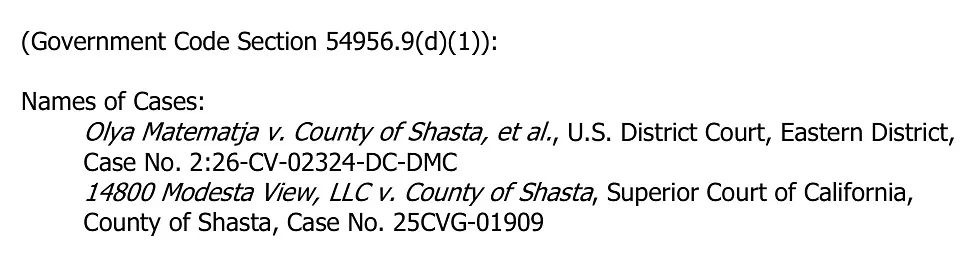
Closed session (R6). The board will discuss two lawsuits. One, 14800 Modesta View, LLC v. County of Shasta, is the appeal by the owners of the Clear Creek Gun Club property — brothers Amrit and Mohit Kulasekaran — of about $106,000 in unpermitted-grading fines and roughly $16,000 in abatement costs; a judge upheld the fines in late June. (A separate criminal case over the same property is not part of this proceeding.) The other, a new federal suit, Matematja v. County of Shasta, has no public footprint yet; its details are not available.
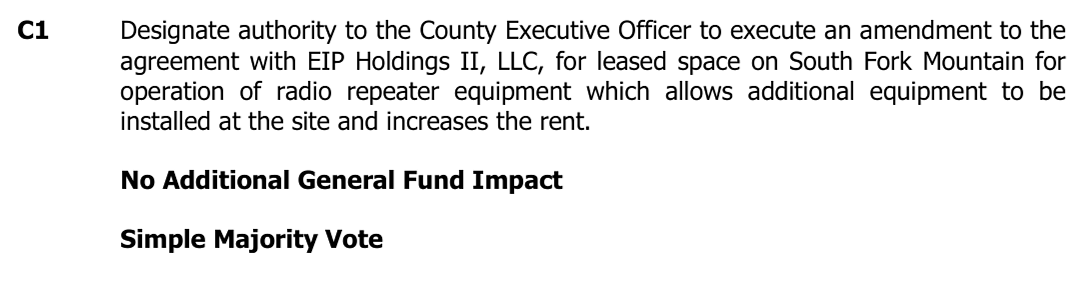
The radio-repeater lease (C1). On consent, item C1 authorizes a CEO-signed amendment to the county's lease for an emergency-radio repeater on South Fork Mountain — adding equipment and $250 a month in rent — with EIP Holdings II, LLC, an entity tied to Everest Infrastructure Partners, a private national buyer of cell- and radio-tower sites.
The November ballot (C3). A consent resolution folds cities’ and districts’ local races onto the November 3 general election — the same ballot that will settle Kelstrom’s runoff against Mike Gallagher. (Crye’s successor, Erin Resner, already won her seat outright in June and takes office in January.) Housekeeping today; the election that reshapes this board in a few months.
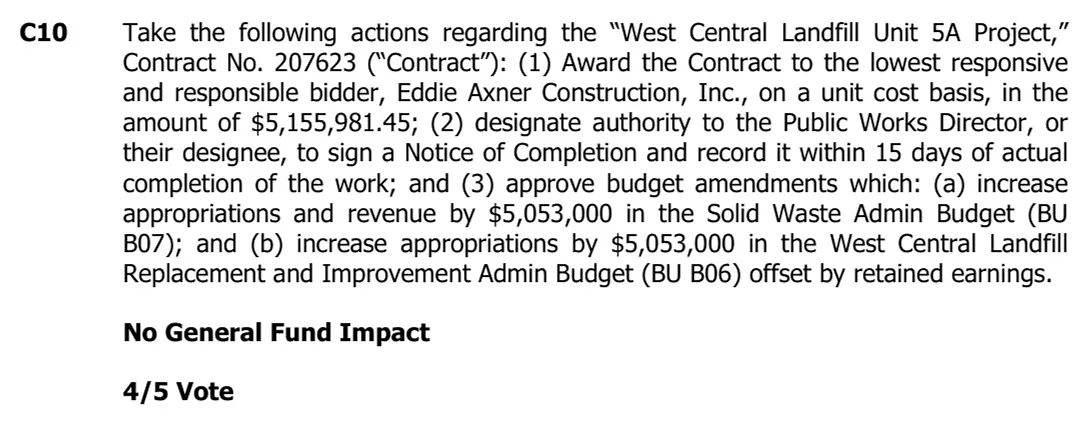
The construction contracts (C10, C11). Two construction awards ride consent: $5.16 million to Eddie Axner Construction for work at the West Central Landfill (part of a $7.05 million project) and $1.58 million to J.F. Shea for pavement rehabilitation on Churn Creek and Balls Ferry roads.
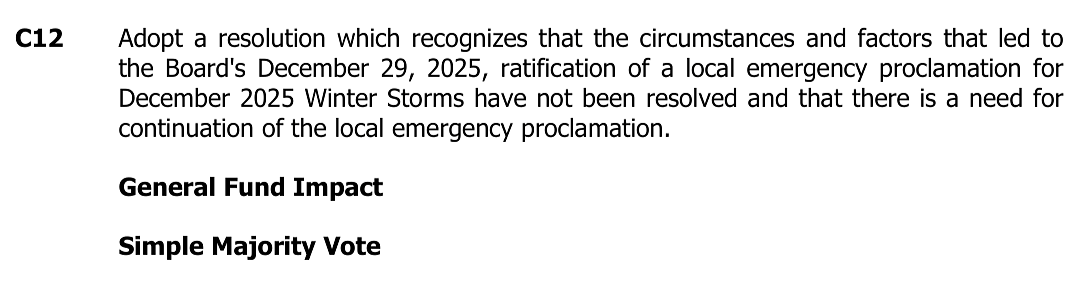
The winter-storm emergency (C12). Once again, the board will extend the local emergency it declared after the December 2025 winter storms — a step it has now repeated through the spring and into summer. The resolution’s own language is the tell: it exists to recognize that the circumstances behind the emergency “have not been resolved.” What it does not do is spend anything or authorize a single repair; it keeps the proclamation alive — a step that keeps the county positioned to seek state and federal disaster aid. The damage was real — the county’s estimate to Cal OES totals roughly $9.3 million across the county, cities, and districts — but the visible repair work in the public record has so far belonged to others. The City of Redding is fronting $4.1 million to rebuild a partially collapsed culvert on Tarmac Road, with 75 percent expected back from the state. What the county itself has done about its share of the damage, beyond renewing the proclamation, is harder to find in the record — and no county reimbursement has yet been booked.
Cannabis money for the sheriff (C13). The board will also accept a $423,612 California Highway Patrol grant — funded by state cannabis-tax revenue — for impaired-driving enforcement, DUI checkpoints, and officer training, renewing a similar grant from last year. Routine on its own. But set beside the opioid items, it points at a pattern worth naming: the county takes cannabis-tax money for enforcement, opioid-settlement money for social workers and a college program, and a state grant for home-visiting nurses. On this agenda, at least, the county runs much of its programming on earmarked outside dollars rather than its own general fund. That is not a scandal — but it makes the accountability question the same one, over and over: who is watching how each restricted pot of money is actually spent?
The rest of consent (C2, C4–C9, and C14). The remaining items are genuinely routine: the county claims list (C2), an evergreen legal-research contract with Thomson Reuters (C4), a run of public-health contract and grant renewals plus a Community Action Agency strategic plan (C5 through C9), and the auction of two surplus county vehicles (C14).
The Question Under the Housekeeping
None of Tuesday's items is a scandal on its own. A college progress report, a consent calendar, a lease amendment — this is the ordinary machinery of county government. But the ordinary machinery is where the interesting questions live right now: why the county's largest opioid grants went to organizations led by the people who recommended them, why the disclosure policy meant to surface exactly that kind of arrangement has not materialized, and why the records behind a six-figure opioid transfer never show its sharpest question — supplantation — being answered. Tuesday won't answer them. It's a good day to ask.
And that's the Agenda Preview