

On the Brink: Shasta County Board Weighs HHSA Furloughs — and Fights the Law That Would Require Notice
 By Benjamin Nowain•May 19, 2026•10 min read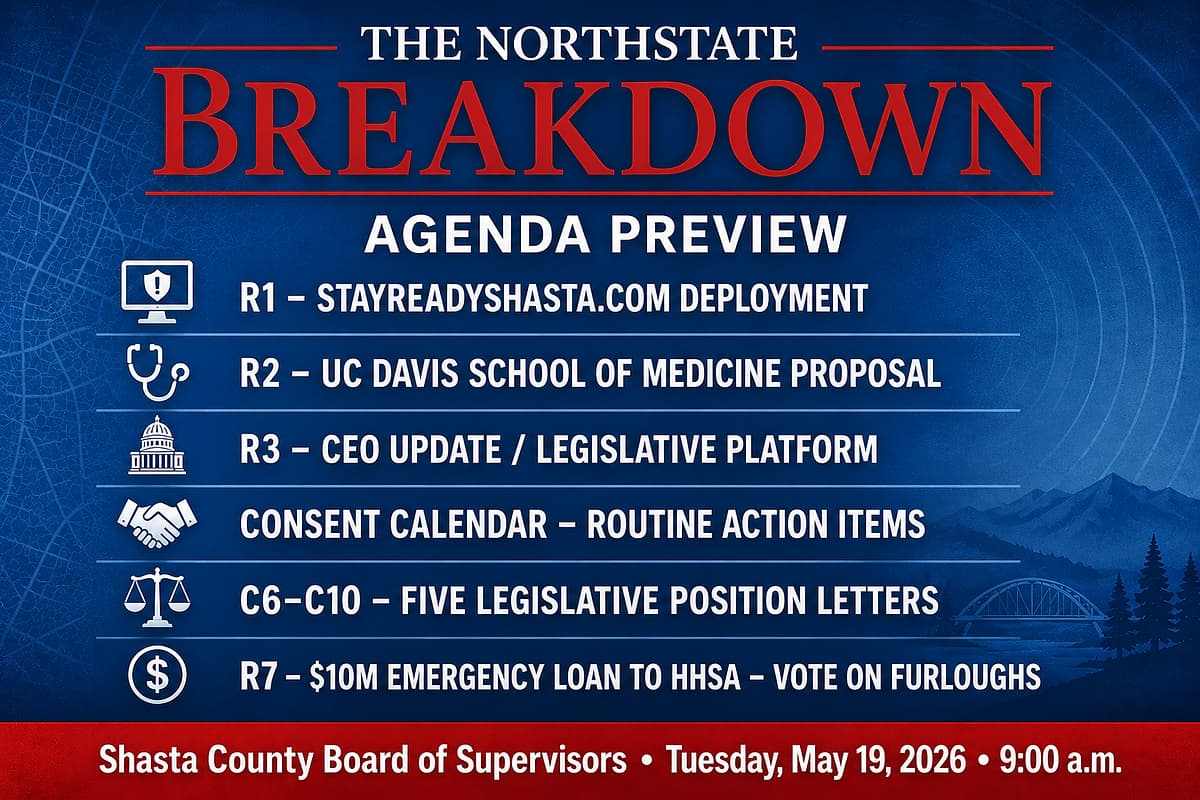
The Shasta County Board of Supervisors holds its next regular meeting on Tuesday, May 19, 2026, at 9:00 a.m. in Board Chambers at the County Administration Center, 1450 Court Street, Suite 263, in Redding.
The agenda is wide, an emergency preparedness portal rollout, a UC Davis medical school proposal, a full consent calendar, and five legislative position letters, but the item with the most direct stakes for county employees is R7: a vote on whether to extend a $10 million emergency General Fund loan to the Health and Human Services Agency while supervisors weigh whether to furlough hundreds of HHSA workers to close a fiscal gap that has widened for more than a year.
The furlough option — cutting employee hours by one day per month to save an estimated $3.7 million annually — sits in uncomfortable proximity to another item also on Tuesday's agenda. In C10, the board is asked to formally oppose AB 2530, a state bill that would extend Cal/WARN Act protections to public agencies, requiring 60 days' advance notice before mass layoffs. The county argues the requirement conflicts with existing civil service and collective bargaining obligations. For HHSA workers navigating a second year of fiscal crisis, that argument may be difficult to separate from its practical consequence: the board weighing whether to cut their hours is simultaneously fighting the law that would require it to warn them first.
R1 — StayReadyShasta.com Deployment
Chief O'Hara presenting on the rollout of stayreadyshasta.com, the county's public emergency preparedness portal. No written staff report in the packet — live presentation only. Worth watching for what the site actually does: notification system, evacuation resource, or public information hub, and what the deployment timeline and outreach strategy look like.
Context: Follows the December 2025 winter storm emergency declaration and the April 2026 Wildfire Coordinator presentation — emergency preparedness has been active on the county's agenda.
R2 — UC Davis School of Medicine Regional Branch Campus (Supervisor Plummer)
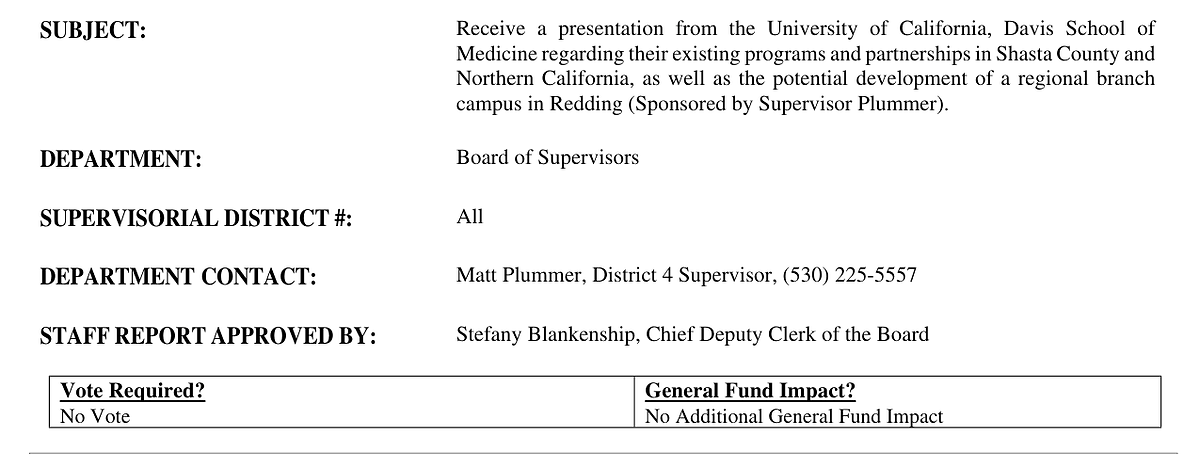
One of the more significant items on the agenda, and the packet is substantial. UC Davis has a deep history in Shasta County — the Family Medicine Residency Network relationship goes back to 1975, and active training partnerships span SCHC and Mercy Redding across family medicine, pediatrics, psychiatry, and a TAVR cardiology clinic at SRMC (since 2020).
The pitch: a formal regional branch campus for 3rd and 4th year medical students, recruited from North State counties, with the explicit goal of building a local physician pipeline.
Graduate data supports the model: 85% of UCD FM network graduates end up practicing in California, 30% in health professional shortage areas, 21% in medically underserved areas, 12% rural.
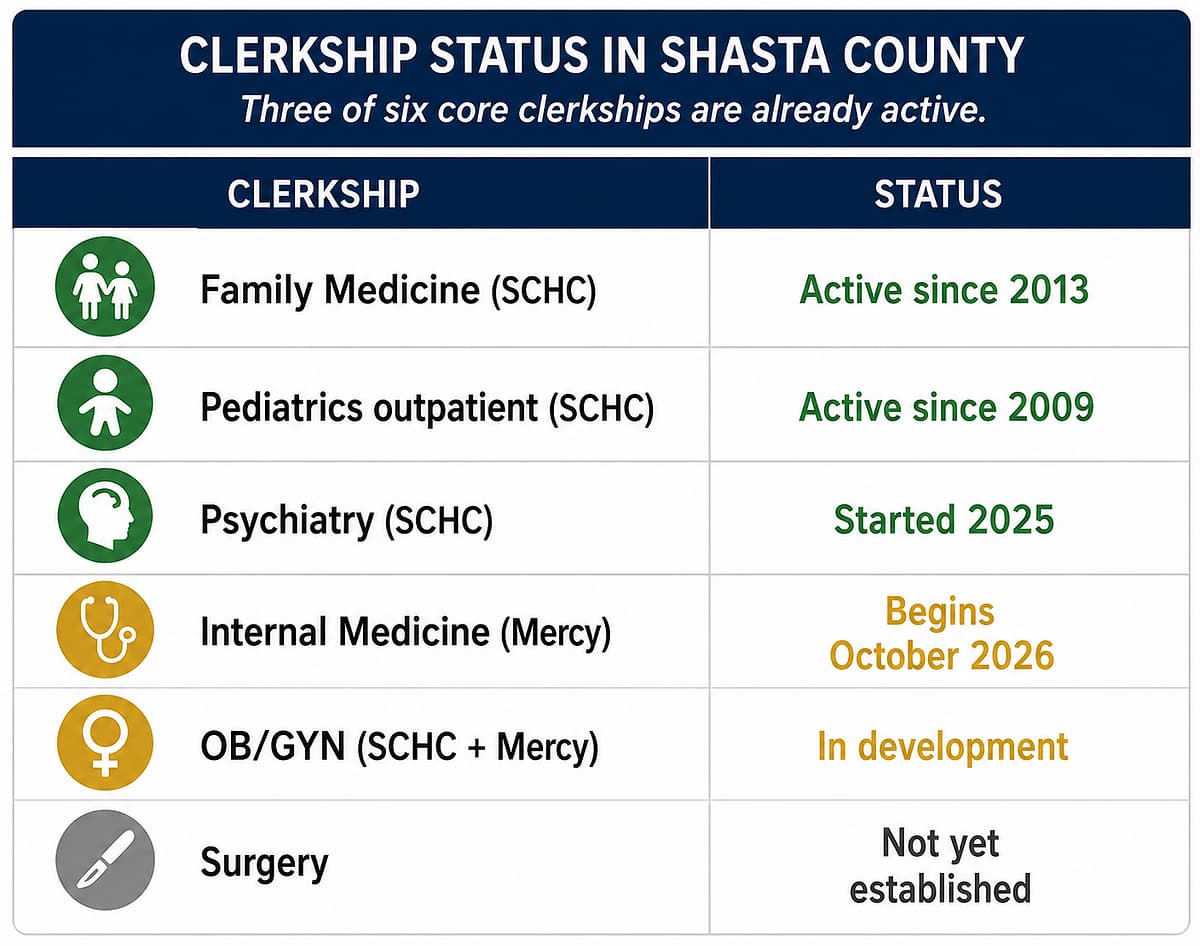
Shasta already has three of the six core clerkships required for branch campus designation:
Projected annual cost for inaugural cohort of 6–8 students: ~$750,000 (scholarships $25–75K/student, associate dean, office/staff, housing). UC Davis provides financial aid, tutoring, and advising as in-kind. Funding model: state appropriations + philanthropy. Comparator: UC Santa Cruz received $1.5M state appropriation for its UCD branch campus.
No vote, no county money requested today. But this arrives four weeks after the board debated a $10M anchor investment in a Simpson University medical school — a church-affiliated institution with contested financials and legal questions. UC Davis offers a publicly-accredited alternative already embedded in local clinical infrastructure. Plummer is the sponsor; watch for board signals on whether county support is on the table.
R3 — CEO Update / Legislative Platform
Covers county issues and specific legislation. The packet contains the five legislative letters (C6–C10 on the consent calendar). Prior BOS meeting minutes in the packet show the Deputy CEO has flagged that pulling individual bills from a legislative package risks missing state deadlines — the board has historically approved these as a batch.
CONSENT CALENDAR
C1 — Veterans Hall / Superior Court Emergency Agreement
Routine. CEO authorized to sign an evergreen agreement letting the Superior Court use the Veterans Hall at 1605 Yuba Street as an emergency backup site when the Court's primary evacuation method is unsafe. Limited to business hours (Mon–Fri, 7:30am–5:30pm). Court Executive Officer gets a key and keycard; if the hall is already occupied, they must share the space without displacing the existing group.
C2 — Fall River RCD / Noxious Weeds ($75K)
Retroactive MOU July 2025–June 2028, up to $75,000. Fully funded by a $120,000 CDFA grant through the Shasta County Weed Management Association. No GF impact.
C3 — First Responder Highway Dedication Plaques (Kelstrom)
Resolution supporting dedication plaques at state highway and freeway county boundaries honoring first responders. This is the local governing body step in a multi-stage process — a separate state legislative joint resolution is still required before physical signage can be installed.
C4 — April 21 & 28 Minutes. Routine approval.
C5 — Burney Cemetery District Appointment. Geoff Stebbins appointed through January 7, 2030.
C6 — Legislation Position: AB 2276: Speed Assistance Devices — OPPOSE
AB 2276 would require DMV to administer a pilot program mandating installation of active intelligent speed assistance (ISA) devices on vehicles driven by people convicted of certain speed offenses — in seven counties including Shasta. The county's opposition letter raises four concerns:
- Unfunded mandate: Bill asserts no state reimbursement required, but creates new compliance, verification, and misdemeanor-processing burdens on local courts, law enforcement, and county admin
- Data privacy: ISA providers collect, store, and may transmit detailed driver behavior data with no meaningful local oversight
- Rural equity: ISA devices depend on accurate GPS speed-limit mapping; rural Shasta County roads may not be reliably represented, risking false violations
- Enforceability: No clear mechanism for the county to verify compliance or address device malfunctions
C7 — Legislation Position: AB 2310: Illegal Dumping — SUPPORT C8 — SB 1230: Illegal Dumping Penalties / CalRecycle — SUPPORT
Both bills address illegal dumping, a chronic rural Shasta problem. AB 2310 creates graduated penalties (misdemeanor at 4+ violations), expands enforcement authority, and increases accountability for commercial dumpers. SB 1230 designates CalRecycle as the lead state agency for resources and best practices, and raises fines for repeat and commercial offenders. The county's letters are substantive and supportive on both.
C9 — Legislation Position: AB 2494: State Forest Management — OPPOSE
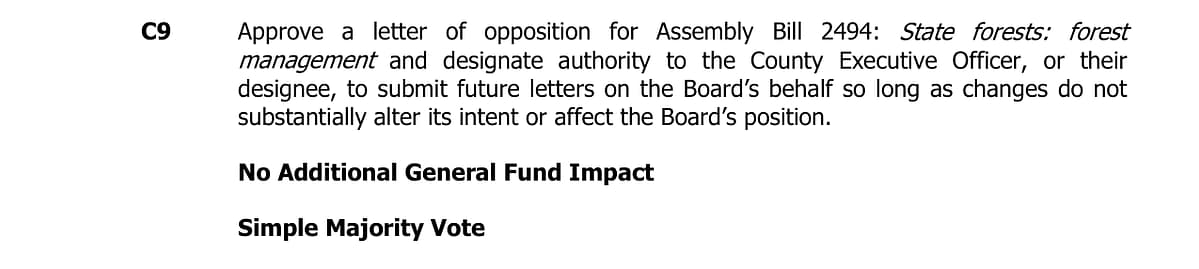
Merits attention for a timber/wildfire county. AB 2494 would significantly alter California's demonstration state forests — operating under a multiple-use "living laboratory" framework for nearly a century (sustainable timber, reforestation, research, recreation, watershed protection).
The county's opposition letter argues:
- Mission shift: AB 2494 replaces the current statutory purpose with a new "management" definition that prioritizes biodiversity and carbon storage and explicitly relegates sustainable timber production to a secondary consideration
- Funding destabilization: Demonstration forests are largely self-sustaining through timber revenue. Restricting harvest without replacement funding threatens the research and wildfire-resilience work those revenues support
- Removed compatible uses: Mining is stripped as an allowable compatible use, narrowing the existing multiple-use framework
- Wildfire risk: County argues science-based active forest management — including timber harvest — reduces wildfire risk. Subordinating that to carbon storage priorities has direct consequences for fire-prone communities
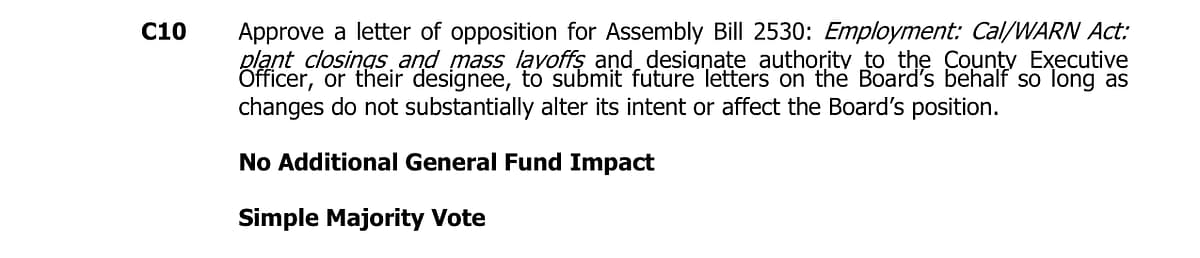
C10 — AB 2530: Cal/WARN Act Expansion to Public Agencies — OPPOSE
The most directly relevant legislative item given the county's current situation.
What AB 2530 does: Expands the California Worker Adjustment and Retraining Notification (Cal/WARN) Act to include public agencies in the definition of "employer" and "covered establishment." Cal/WARN currently applies to private employers with 75+ employees and requires 60 days' advance written notice before mass layoffs, plant closings, or relocations. AB 2530 would apply that same framework to county government.
The county's objections:
- Overlapping obligations: Public agencies already operate under civil service rules, collective bargaining agreements, and statutory layoff procedures. Cal/WARN adds potentially conflicting notice requirements and timelines on top of existing MOU and civil service commission processes
- Exception too narrow: The only exemption is physical calamity or act of war — leaving out sudden state or federal funding cuts, mid-year budget shortfalls, and emergency service restructuring. This is not hypothetical: HHSA is currently navigating a potential agency-wide furlough driven by federal H.R. 1 impacts on Medi-Cal and SNAP
- Operational inflexibility: A 60-day notice clock during an active funding crisis could require the county to continue paying employees it literally cannot afford while waiting out the notice period
- No fiscal carve-out: No exception for workforce reductions mandated by loss of funding outside the county's control
The worker-rights tension: The county frames this as a structural legal conflict, not an anti-worker position. But the gap AB 2530 is trying to close is real — public employees currently have fewer advance-notice protections than private-sector workers facing mass layoffs. An HHSA employee who just learned they may be furloughed one day per month may not find "we already have civil service rules" a satisfying answer.
Direct connection to R7: If the board approves the HHSA furlough option at R7 today, and AB 2530 passes later this session, those two decisions would be in direct conflict. The county is opposing the bill that would require it to give workers the notice it is not currently planning to give.
C11 — Raising Shasta / Child Abuse Prevention
Retroactive renewal subaward with Shasta County Child Abuse Prevention Coordinating Council (dba Raising Shasta) for Community Based Child Abuse Prevention programming. Up to $69,480 through June 2028. Routine.
C12 — HHAP-3 / Training, Employment & Community Help (TECH)
Revenue agreement for Homeless Housing, Assistance and Prevention Round 3 funds. HHSA Director authorized to sign future amendments. Routine.
C13 — A10 Networks IT License
FlexPool Thunder Application Delivery Controller subscription from CDW-G through April 30, 2032. CEO may authorize renewals so long as per-license increases don't exceed 10% annually. Network infrastructure. Routine.
C14 — Development Group Cloud Access
Similar cloud/IT terms and conditions approval. Routine.
C15 — Noble Software Group / Probation Assessment Software
Renewal of web-based assessment software used by Probation. Routine.
C16 — GEO Reentry Services / Juvenile Rehab ($1,439,541)
Renewal of agreement for interventions and programming at the Juvenile Rehabilitation Facility and River's Edge Academy. Not trivial in dollar terms. Sits in context of ongoing county debate about correctional reform — Supervisor Plummer flagged correctional fiscal accountability as a priority in October 2025, and a proposed correctional campus drew neighborhood opposition in November 2025.
C17 — Fall River Mills Septage Impoundment Cleanout
CEQA categorical exemption (Class 1 — Existing Facilities). Plans and specifications approved. Bids open on or after June 18, 2026. Public works, routine.
C18 — Old Shasta County Courthouse Demolition
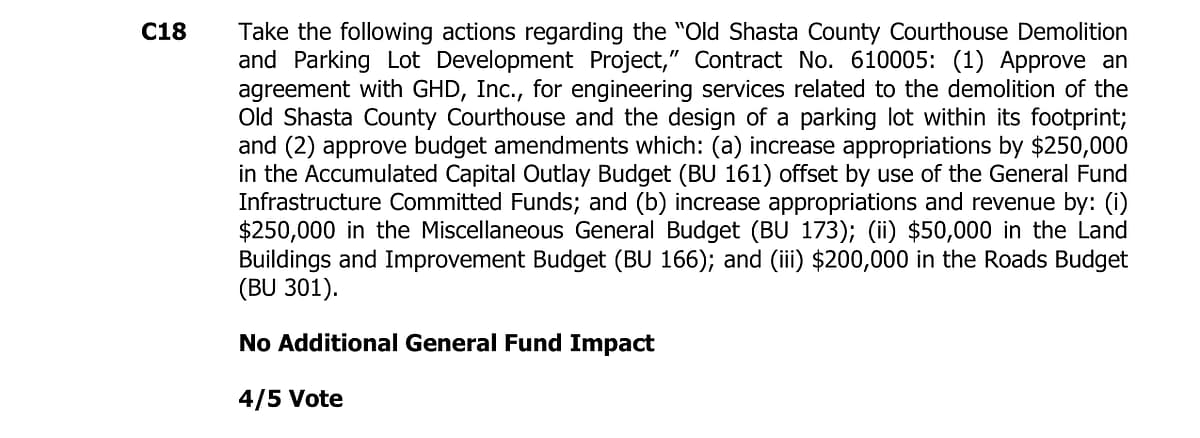
Engineering services agreement with GHD Inc. for demolition design and parking lot development within the courthouse footprint. Budget amendment: $250,000 appropriation increase in the Accumulated Capital Outlay Budget (BU 161), offset by General Fund Infrastructure Committed Funds. This is the formal step to demolish the old courthouse and replace it with surface parking.
R4 — Local Planning Council Child Care Priorities
Routine. The board is asked to approve the Local Planning Council's County Priorities Report Form for submission to the California Department of Education — the annual document identifying which Shasta County zip codes receive priority for state child care and development funding under Welfare and Institutions Code sections 10485 and 10486. The LPC is the body responsible for local child care planning and resource allocation. No general fund impact. Simple majority vote.
R5 — 2026-2031 County Strategic Plan
The board will receive a presentation on the county's proposed five-year strategic plan and consider approving it. Strategic plans set the stated priorities for county departments across services, staffing, and resource allocation over a five-year horizon. This one arrives at a moment when several of those departments are under significant fiscal strain — most visibly HHSA. Worth watching for how the plan frames priorities in health and human services, public safety, and infrastructure relative to the budget pressures visible elsewhere on this same agenda. No additional general fund impact. Simple majority vote.
R6 — Shasta Lake Drone Show ($24,000) (Supervisor Plummer)
A budget amendment drawing $24,000 from the Reserves for Contingencies budget to fund a drone show at Shasta Lake in partnership with the Shasta Lake Chamber of Commerce. The stated purposes: encourage tourism, promote outdoor activities, and commemorate the 250th anniversary of the founding of the United States. Requires a 4/5 vote because it carries a general fund impact — the $24,000 comes from contingency reserves. Sponsored by Supervisor Plummer.
On an agenda where the board is simultaneously weighing whether to furlough HHSA employees due to a 14-month fiscal crisis, the optics of an optional discretionary expenditure from reserves may draw comment. The board has approved similar promotional items before; whether it does so without discussion here will be telling.
R7 — HHSA Budget Crisis: $10 Million Loan Extension and Cost-Saving Decision
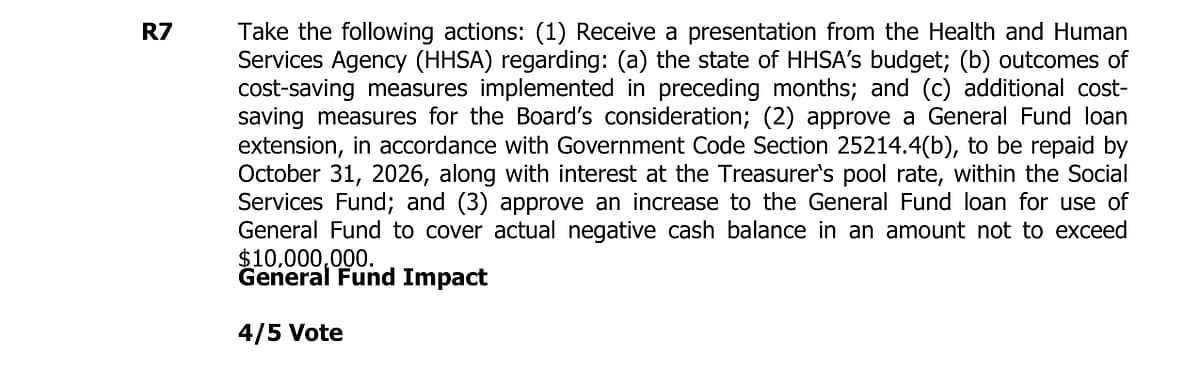
The fiscal centerpiece of the meeting. The board will take up three actions in sequence: hear a full presentation from the Health and Human Services Agency on the state of its budget and the outcomes of cost-saving measures already implemented; consider additional cost-saving options including a potential furlough; and vote on extending and expanding a General Fund emergency loan to cover HHSA's actual negative cash balance in an amount not to exceed $10,000,000, to be repaid by October 31, 2026, with interest at the Treasurer's pool rate within the Social Services Fund.
The crisis has been building since March 2025, when the board first authorized a General Fund bridge loan to cover HHSA's shortfall. What followed was a series of rolling extensions — each one a recognition that the underlying problem had not been resolved. The current ask raises the loan ceiling to $10 million and pushes the repayment deadline to October. Repayment sources include the the California 800 Assistance Claim, 1991 and 2011 Realignment revenues, and other state program reimbursement streams — all of which depend on state and federal program reimbursements that are themselves under pressure from H.R. 1 impacts on Medi-Cal and SNAP.
The cost-saving options the board will consider include a furlough of HHSA employees — one day per month — estimated to save approximately $3.7 million annually. Other options in the packet include additional administrative restructuring and program adjustments. The board's direction on which measures to pursue will be the most consequential decision of the day, with direct implications for hundreds of county employees. Requires a 4/5 vote. General fund impact.
R8 — Public Health Suicide Prevention Program
The Shasta County Public Health Suicide Prevention Program will present key data, current funding sources, and program activities, with the board considering whether to provide direction to staff. No additional general fund impact. Simple majority.
Mental health and suicide prevention programs sit within HHSA's broader portfolio. This presentation arrives on a day when that agency's fiscal future is uncertain and when cost-cutting measures — including potential furloughs — are on the table. Worth watching for any signals about program sustainability or funding gaps, and whether the board's direction to staff reflects awareness of the fiscal constraints bearing down on the department presenting.
CLOSED SESSION (R9)
The board will recess to closed session (estimated 20 minutes) for conference with legal counsel on three existing litigation matters under Government Code Section 54956.9(d)(1):
- Jimmy Gettings v. County of Shasta et al. — U.S. District Court, Eastern District of California, Case No. 2:21-CV-1139-DAD-DB. Federal case filed 2021; nature of claim not specified in the public packet.
- County of Shasta et al. v. California Energy Commission et al. — Shasta County Superior Court, Case No. 23CV-203737. The county is the plaintiff.
- Jeffrey Gorder v. David Rickert et al. — Shasta County Superior Court, Case No. 25CV-0207689. Filed 2025; names CEO David Rickert personally. Any reportable action in open session would be significant.
WHY THIS MEETING MATTERS
Tuesday's meeting arrives at a moment of compounding pressures. HHSA's fiscal crisis, now in its second year, has reached a point where the decisions are no longer purely internal — they land directly on the paychecks of hundreds of county employees. The UC Davis presentation offers something different: a long-range investment case for building local healthcare infrastructure, not cutting it. And five legislative opposition letters reflect a county that increasingly frames its relationship with Sacramento as adversarial on workforce, environmental, and enforcement questions alike. The C10/R7 intersection — opposing Cal/WARN expansion while considering furloughs — is the most telling thread on this agenda. Whether any supervisor acknowledges that tension in open session will be worth watching.
And that's the agenda preview.