

Lame-duck Crye finalizes his two redo charter measures at the meeting that certifies his own defeat.
 By Benjamin Nowain•July 14, 2026•12 min read
REDDING — The Shasta County Board of Supervisors will take the final step Tuesday to place two charter amendments on the November ballot — reruns of measures county voters rejected in 2024 — at the same meeting where the board formally certifies the June 2 primary in which the measures' sponsor, District 1 Supervisor Kevin Crye, lost his seat. One of the two actions also quietly repeals and replaces a resolution the board adopted just three weeks ago, after staff discovered it contained the wrong ballot language.
The certification item makes Tuesday's meeting an unusual bookend: the board will declare Redding City Council member Erin Resner elected to Crye's seat, declare longtime assistant registrar Joanna Francescut the winner over appointed Registrar of Voters Clint Curtis — who as the county's chief elections officer prepared the very certification declaring his own defeat — and certify the passage of Measure B, the election-overhaul charter amendment the state has already sued to invalidate. All of it will unfold under brand-new public-comment time caps that take effect at this meeting for the first time: two minutes per speaker, 20 minutes per item, 30 minutes for open time. Also on the agenda: a $565,000, 90-month software contract for the Public Defender riding the consent calendar under a "no additional General Fund impact" label, support letters for two state election bills, and a closed session on the lawsuit challenging the county's planned corrections campus on Eastside Road. Here is a look at the major items.
TWICE-REJECTED, TWICE REVIVED: MEASURES E AND F HEAD TO THE NOVEMBER BALLOT (R3, R4)
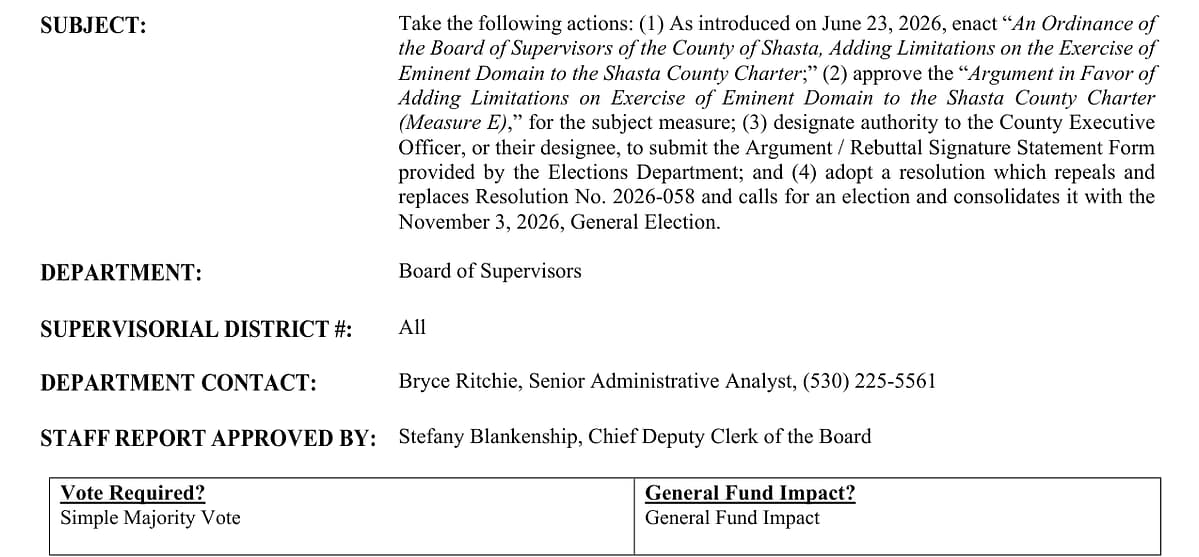
The board's biggest actions Tuesday are the final enactment votes on two Crye-sponsored charter amendments, which the board introduced June 23. Both go before voters November 3.
Measure E (R3) would bar the county from using eminent domain to take private property in order to hand it to another private party — the "economic development" takings the U.S. Supreme Court allowed in its 2005 Kelo decision. The ordinance text is narrow: it does not touch eminent domain for public uses like roads or bridges. Voters saw this measure before as 2024's Measure P, which failed by 358 votes. The county's own staff report acknowledges the 49.78 percent near-miss.
There is no new taking or land dispute behind the revival. In 2024, a Public Records Act response from Public Works found the county had used eminent domain 27 times since 1976, only twice since 2000 — and never once to transfer property to a private owner, meaning the practice Measure E bans has never occurred in Shasta County. Then-Supervisor Mary Rickert told the Record Searchlight in 2024 the county had used the power "three times" in 25 years, "for two bridges and a bike lane." Opponents of the 2024 version, including former Redding Mayor Julie Winter and former Supervisor Timothy Garman, argued eminent domain "is already controlled tightly by existing law" — and that the decision should be left to incoming supervisors. That objection now rhymes: the current board's action will be complete before Resner and the winner of the District 5 runoff are seated in January 2027.
Measure F (R4) governs what happens when one of the county's six elected department heads — the sheriff, district attorney, assessor, auditor, treasurer or county clerk-registrar — leaves office early. Under the ordinance's text, the board would be required to call an election to fill the vacancy whenever a regularly scheduled election falls within 12 months; only if none does may the board appoint, and then only through an open recruitment with public interviews and a four-fifths vote. Its 2024 predecessor, Measure Q, which would have merely given the board the option of a special election, failed with 58.52 percent voting no. The new version is materially tighter than the one voters rejected — the election is mandatory when available, and an appointment needs a supermajority — though the staff report itself never mentions the 2024 defeat.
The backstory is the 2024 appointment of Tom Toller as registrar of voters: under state default rules the board could not call a special election and seated Toller for the full two-year remainder of the term. No current vacancy would trigger the new rules.
At the June 23 introduction, per the meeting's recorded roll calls, Measure E passed 3-2 with Supervisors Allen Long and Matt Plummer dissenting; Measure F passed 4-1 with Long alone opposed. Crye made the motion on both. Long argued the vacancy measure duplicates existing state law and called the spending "a waste of money" at the meeting. The packet puts the election-revenue cost at $20,000 to $50,000 per countywide measure — up to $100,000 for the pair.
The do-over inside the do-over: Tuesday's Measure E item also repeals and replaces Resolution 2026-058, the election-call resolution the board adopted June 23. The staff report says the resolution "contains inaccurate ballot measure language and references filling vacancies by special election rather than restricting the use of eminent domain" — the two companion measures' ballot questions were cross-wired. The fix is presented as clerical, and the corrected ballot question now before the board matches the eminent-domain ordinance.
THE BOARD WILL CERTIFY THE ELECTION THAT UNSEATED CRYE AND CURTIS — AND PASSED MEASURE B (R5)
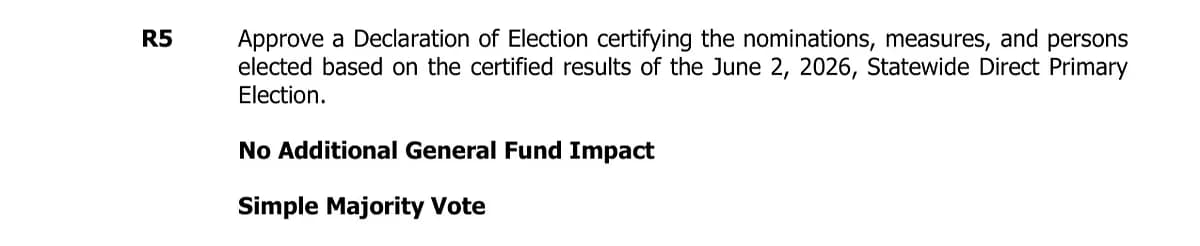
The Declaration of Election is ministerial — Elections Code Section 15400 requires the board to declare the certified winners, and the staff report lists no recommended alternatives — but the results it makes official are anything but routine for this board:
• District 1: Erin Resner defeats incumbent Kevin Crye. Resner takes office in January 2027.
• Registrar of voters: Joanna Francescut defeats appointed incumbent Clint Curtis 57.97 percent to 42.03 percent — a 7,998-vote margin. Curtis, appointed over Francescut on a 3-2 board vote in spring 2025, prepared the certification as the county's elections officer; his name appears on the canvass the board will now declare.
• Measure B: the election-overhaul charter amendment — precinct hand-counting, voter ID, one-day voting, locally maintained rolls — passes with 55.59 percent. It is already in court: Attorney General Rob Bonta and Secretary of State Shirley Weber sued in June to invalidate it as preempted by state law, and the board voted 4-0 on June 16 (Crye absent) not to spend county money defending it, leaving the defense to the measure's private proponents, as Shasta Scout reported.
• District 5: Chair Chris Kelstrom did not win his seat outright and heads to a November runoff against Mike Gallagher.
• Unopposed countywide officers (Assessor-Recorder Leslie Morgan, Auditor-Controller Nolda Short, Treasurer-Tax Collector Loretta Schroeder) and Superintendent of Schools Mike Freeman are also declared.
What's not on the agenda: on June 23 the board voted 4-1 — Crye dissenting, calling it "a waste of time," per the meeting's recording — to bring a censure of Curtis back once the election results were certified. No censure item appears anywhere in Tuesday's 205-page packet. Two county investigation reports this spring documented findings of misconduct against Curtis, including threats of workplace violence and campaign activity on county time, as Shasta Scout has reported. Whether the censure returns after Tuesday — or is quietly dropped now that voters have removed him — the agenda does not say. Also absent: the nonprofit-funding transparency policy the board twice promised for early summer.
NEW PUBLIC-COMMENT CLOCK STARTS TUESDAY: 2 MINUTES A SPEAKER, 20 MINUTES AN ITEM
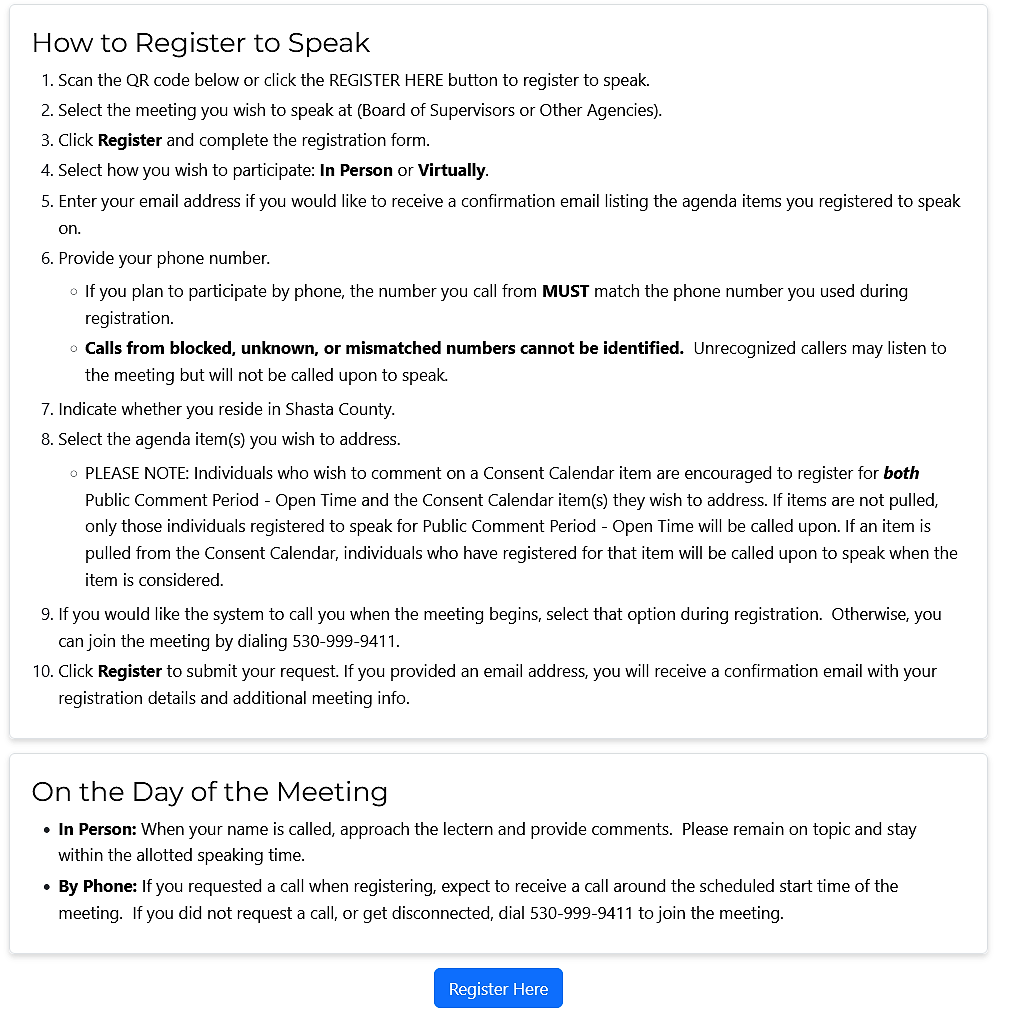
Tuesday is the first board meeting governed by the county's new public-comment rules, adopted June 23 as Administrative Policy 1-101 and effective July 1. Printed in the agenda itself: speakers get two minutes each; total public comment is capped at 20 minutes per regular-calendar item and 30 minutes for the open-time period; a "Running Timer" starts with the first speaker; the first half of each comment period is reserved for in-person speakers and the second half for telephonic callers; and online speaker registration opens at 8 a.m. the morning of the meeting.
The trigger is Senate Bill 707, a state overhaul of the Brown Act's teleconference rules effective July 1 that requires larger counties to offer two-way remote participation and — under new Government Code Section 54953.4 — to give remote commenters "the same time allotment" as people in the room. But the specific numbers are Shasta County's choices, not the state's: nothing in SB 707 imposes a 2-minute speaker limit, a 20-minute item cap, a 30-minute open-time cap or the running timer. Those come from the county's own policy implementing the statute.
The adopted policy — revised June 30 on the county's books — matches the agenda's numbers, and adds that the chair keeps authority to adjust the totals. Some ideas floated when the board took the policy up June 23 did not survive into the final text: a registration kiosk outside the chamber and a requirement that speakers provide a phone number and declare county residency, described in a meeting recap by Shasta Unfiltered, whose editors are listed proponents of Measure B, appear nowhere in the adopted policy.
The caps arrive against a documented history of friction over public comment in the county chambers. At the June 23 meeting, Crye complained that each three-minute speaker costs the county "$1,600 – $1,700 in staff time," and one regular commenter called Chair Kelstrom "the muzzler," according to Shasta Unfiltered's recap. In May 2025, County Counsel Joseph Larmour pulled the microphone from a commenter mid-sentence and then-Chair Crye had the chamber cleared and the speaker banned for the rest of the meeting — actions the First Amendment Coalition's legal director said likely violated the Brown Act and the First Amendment, in Shasta Scout's account of the incident, which it described as the third time in a year a member of the public had been barred from returning to a meeting. Kelstrom said in June the new limits "will be re-evaluated as needed," per Shasta Unfiltered's recap.
A $565,000, 90-MONTH SOFTWARE DEAL LABELED "NO ADDITIONAL GENERAL FUND IMPACT" (C5)

On the consent calendar — approved in a single vote unless pulled — the Public Defender asks the board to approve a digital-evidence contract with Axon Enterprise Inc. worth up to $565,535.85 over 90 months, or seven and a half years. This is not body cameras: the contract buys 45 licenses to Axon's Evidence.com platform so defense staff can directly access digital evidence shared by the District Attorney's office, instead of downloading files that expire after roughly 90 days on the DA's portal. The staff report touts the package's AI features, including automatic transcription and "AI-assisted" evidence summaries.
The agenda's fiscal line reads "No Additional General Fund Impact," but that describes only the first year: $82,287.71 is budgeted in the Public Defender's existing 2026-27 budget, while the remaining years — roughly $73,404 annually — depend on future annual budget requests. The contract's payment obligations, meanwhile, are described in Axon's master services agreement as non-cancelable, and the quote states "all sales are final." The county is not bidding this out: the purchase piggybacks on a Sourcewell cooperative contract, a common government purchasing route that means no independent Shasta County competitive process for the vendor selection.
The deal deepens a county relationship with Axon that began in December 2024, when the board unanimously approved a five-year, $1,987,535 contract for 180 sheriff's body cameras, as the Record Searchlight reported. And it follows the June budget hearings, where the board granted the DA's and Public Defender's requests for an Axon AI extension amid a prosecutor staffing crisis, per Shasta Scout. One question the packet does not answer: Axon's quote paperwork incorporates a data-sharing program under which "de-identified segments of Agency Content" may be shared with Axon to develop new products — and the packet is silent on whether that program has been scoped out for privileged defense case files.
A HAND-COUNT COUNTY'S BOARD BACKS TWO BALLOT-ACCESS BILLS (C1, C2)
Also on consent, and both sponsored by Supervisor Matt Plummer: letters of support for two state election bills. AB 2604 would create a uniform statewide process for voters to fix a rejected vote-by-mail signature — including by text message — and the county's draft letter says the change "would preserve the signature-match safeguard that keeps unverified ballots out of the count, while ensuring that a verified, eligible voter is not turned away over a clerical mismatch." SB 1420, the "Sign, Scan & Go" bill, would let a voter bring a completed mail ballot to a voting site and have it scanned and counted on the spot; the staff report cites a Placer County pilot that cut processing time by three to four days.
Neither bill has reached the governor's desk. AB 2604 passed the Assembly 58-20 in May and cleared the Senate elections committee; it now sits in Senate Appropriations, which voted 4-1 to advance it June 30 and has a further hearing set for August 3, according to the Legislature's bill-status page. SB 1420 passed the Senate 39-0 and cleared the Assembly's elections committee 7-0 with a consent-calendar recommendation; it awaits action in Assembly Appropriations.
The letters are a notable posture for this particular board — one whose majority has championed precinct hand-counting and whose voters just passed Measure B — landing on the same agenda that certifies the ouster of Curtis, the election-skeptic registrar the board appointed. Neither staff report addresses the timing; both sell the bills in election-integrity terms.
CONSENT CALENDAR NOTABLES
Three of Tuesday's consent contracts rest on notably thin competition: a $130,500 septage-pond cleanout at Fall River Mills went to MidCal Dredging on the only bid received, 13 percent above the engineer's estimate (C6); a three-year, up-to-$220,000 building-management-systems award to Shasta Control Co. drew a single response to the county's request for qualifications (C8); and a psychological-evaluations contract extension with UC Davis Health (C4, $120,000 cap unchanged) cites "multiple competitive procurement cycles... with limited responses." Elsewhere on consent: a $100,000 increase to an on-call hazardous-materials contract (C9); a $292,400, six-month medical case-management agreement for a severely injured county worker, whose costs are expected to exceed even that cap (C10); and a $4,935 legal-training retainer renewal (C11).
LIGHTER FARE: PROBATION WEEK AND AN IRONMAN
The board will proclaim July 19-25 Probation Services Week (R2, sponsored by Long), with a presentation from Chief Probation Officer Tracie Neal; the department supervises roughly 1,800 adults and 100 juveniles and this spring launched a mobile probation office to reach rural and homeless probationers, as the Record Searchlight reported in April. And the board would delegate lane-closure authority to Public Works for the Ironman Group's races (C7) — starting with the first annual Ironman 70.3 triathlon in August 2026: a 1.2-mile swim in Whiskeytown Lake, a 56-mile bike ride through Old Shasta, Keswick, Bella Vista and Palo Cedro, and a 13.1-mile run along the Sacramento River. County Executive Officer David Rickert also delivers his periodic update (R6), which carries no staff report and no vote.
CLOSED SESSION: THE CORRECTIONS-CAMPUS LAWSUIT, AND A CASE ABOUT WHICH ALMOST NOTHING IS PUBLIC (R7)
The board ends Tuesday in closed session on two pieces of existing litigation, estimated at 30 minutes. The first is River Ranch Neighborhood Association v. City of Redding et al. (Shasta County Superior Court case No. 210023), the California Environmental Quality Act challenge to Redding's 2025 lease of about 90 acres on Eastside Road to the county for $1 — the site of the sheriff-driven "Alternative Custody Campus," a corrections and reentry complex with land reserved for future jail expansion. The neighborhood association argues the city approved the lease under a surplus-property exemption without environmental review of the correctional use, and asks a court to suspend the project pending a full environmental impact report. Court-supervised settlement talks were reported as productive this spring, but as of a community meeting in early July the case remained in litigation, per Shasta Unfiltered. The county — lessee and intended operator — continues design work in the meantime, including a reported $192,000 architectural contract.
The second case is Raymond McDowell v. Redding Area Bus Authority et al. (case No. 210560). RABA, the regional bus operator, is a joint powers agency whose members include the city of Redding and Shasta County, which explains the county's seat at the closed-session table.
The Board of Supervisors meets at 9 a.m. Tuesday in the Board of Supervisors Chambers, 1450 Court Street, Suite 263, Redding. The invocation is by Pastor Matthew Brown of Oak Run Bible Church, and Supervisor Plummer leads the pledge. The meeting is streamed on the county website. Under the new rules, anyone who wants to speak remotely must register online starting at 8 a.m. Tuesday.
And that's the agenda preview.