

Kevin Crye Revives Two Rejected Charter Measures for the November Ballot, Supervisors Adopt a $658 Million Budget and Backfill $235,057 in Victim Services, Discuss AI initiatives
 By Benjamin Nowain•June 21, 2026•11 min read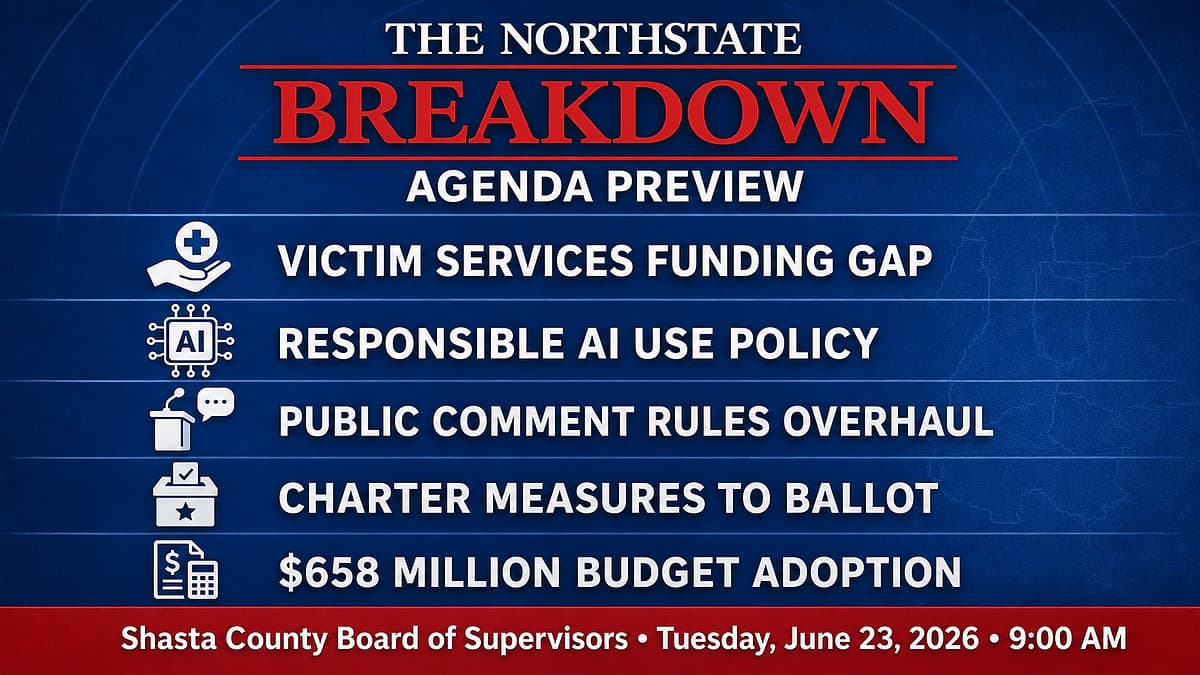
REDDING — The Shasta County Board of Supervisors returns Tuesday to finish business it started a week earlier, taking the formal first votes to send two charter amendments to the Nov. 3 ballot — one limiting the county's eminent-domain power, the other changing how vacancies in elected department-head offices are filled — both revivals of measures county voters rejected in 2024. The board also will adopt the $658 million budget for fiscal 2026-27 that emerged from three days of hearings in June, and weigh a retroactive $235,057 General Fund infusion to keep the District Attorney's victim-services program whole after a second straight year of missing state reimbursements.
Rounding out a dense regular calendar are a resolution affirming "responsible" use of artificial intelligence across an understaffed county workforce, a package of public-comment rule changes driven by a new state open-meetings law that takes effect July 1, and a consent calendar carrying a five-year audit contract worth up to $627,200, a meeting-software amendment worth up to $612,187.80, and the Sheriff's annual military-equipment report. Here is a look at the major items on the agenda.
CALL TO ORDER (OPENING)
The meeting opens at 9 a.m. with an invocation by Pastor Tom Lucatorta of Heritage Baptist Church and the Pledge of Allegiance led by Supervisor Allen Long, followed by the board's standard period of public comment on closed-session items before the regular business begins.
PUBLIC WORKS PREVIEWS SUMMER ROAD WORK ACROSS NINE ASSESSMENT ZONES (R1)
Public Works opens the regular calendar with a status presentation on the county's Permanent Road Division zones, the special assessment districts that fund maintenance on otherwise private and unincorporated roads. Sponsored by Supervisor Matt Plummer, the item carries no vote and no General Fund cost. Staff plan to outline maintenance scheduled for summer 2026 across nine zones, including Woggon Lane in District 1; Logan Road, Palo Cedro Oaks and Robledo Road in District 3; Shasta Lake Ranchos, Shasta Meadows Drive and Sonora Trail in District 4; and Manton Heights and Sleeping Bull Estates in District 5.
The presentation lands against a backdrop of fund stress that Public Works previewed during the June 10 budget hearing, where staff described a declining PRD fund balance and a shrinking inventory of undeveloped gravel-road lots, and characterized the division as operating like a "loan bank" — assessments repay a dust-mitigation account that fronts the cost of paving. Public Works overall contributes about $1.2 million from the General Fund this year, a roughly $33,000 decrease from the prior year.
DA SEEKS $235,057 TO COVER VICTIM SERVICES AS STATE REIMBURSEMENTS STALL (R2)
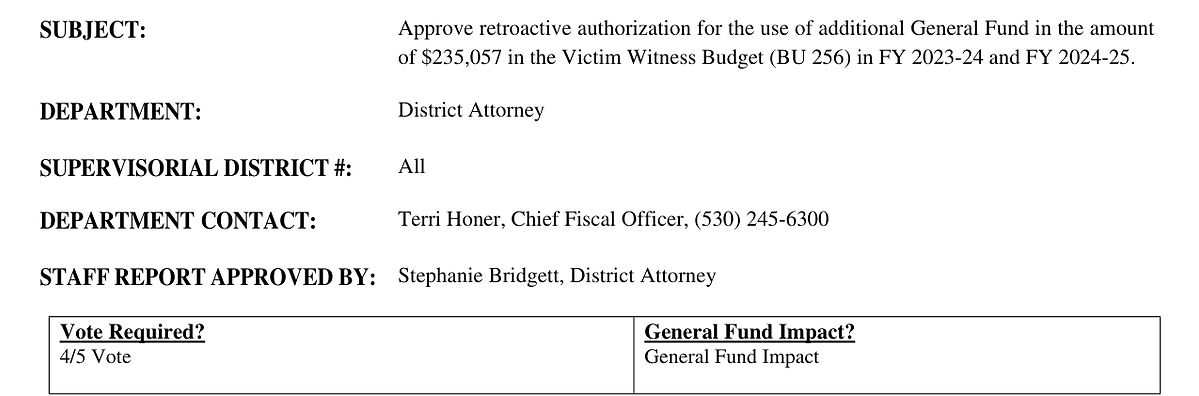
District Attorney Stephanie Bridgett asks the board to retroactively authorize an additional $235,057 in General Fund money for the Victim Witness program, Budget Unit 256, covering fiscal years 2023-24 and 2024-25. Because the authorization is retroactive and adds General Fund appropriations, it requires a four-fifths supermajority. The request, presented with Chief Fiscal Officer Terri Honer, traces to an April 30, 2026 memo from Auditor-Controller Nolda Short on the final fiscal 2024-25 budget adjustment.
The driver, according to the staff report, is that for the second consecutive year revenue from the California Victim Compensation Board did not materialize. CalVCB — the statutory "payor of last resort" for crime-victim reimbursement — owed the county roughly $698,000 as of May 2026. The state board's troubles are well documented: CalMatters reported in March 2025 that CalVCB, under a court order to revise its claims-denial practices, had told the Legislature it "will remain unable to meet its legal obligations" and would leave "victims of crime waiting in limbo" without additional staffing. The backfill arrives as the DA's office contends with prosecutor staffing losses, and as county finance staff noted in the June 9 budget hearing that such reimbursements tend to "come two years in arrears." The board has shown comfort with retroactive accounting this cycle, approving a retroactive use of retained earnings on a 4-0 vote June 16.
CONSENT CALENDAR HIGHLIGHTS
The 15-item consent calendar is approved in a single vote unless a supervisor or member of the public pulls an item. The largest dollar figures and the items of broadest public interest:
C2 — Five-year external audit contract up to $627,200: The board would engage CliftonLarsonAllen, a major California local-government auditing firm, for fiscal years 2026 through 2031 at a not-to-exceed cost of $627,200, and extend the firm's prior fiscal 2021-25 federal Housing REAC reports through Dec. 31, 2026. The contract is brought by Auditor-Controller Nolda Short.
C4 — Granicus meeting-software amendment up to $612,187.80, doubling hosted meetings: A third amendment to the county's agenda-and-streaming software contract would run through June 30, 2030, at a not-to-exceed cost of $612,187.80 and raise the number of hosted and indexed meetings from 25 to 50 a year. The contract originated in 2022 with Rock Solid Technology, which Granicus acquired in October 2022. The item sits in pointed adjacency to R5: a Granicus-class platform is exactly the kind of system the new state open-meetings mandates will require.
C8 — Kings View mental-health contract raised by $385,400 to $2,291,869: An amendment would increase the county's behavioral-health services agreement with Kings View by $385,400, to a new total of $2,291,869. The increase comes as the county's Health and Human Services Agency manages a roughly $19 million structural deficit in social services and after the board imposed an 18 percent administrative-cost cap on nonprofit contractors June 8.
C15 — Sheriff's annual military-equipment report: Lt. Rob Sandbloom and Sheriff Michael L. Johnson submit the department's annual report on controlled equipment for the period Jan. 1 through Dec. 31, 2025, as required by Assembly Bill 481 (Chiu, 2021), with the governing Ordinance 764 and Lexipol Policy 704 attached. AB 481 requires law-enforcement agencies to report annually, in a public meeting, on equipment such as drones, armored vehicles, rifles, less-lethal launchers and chemical agents, and gives the governing body its yearly chance to review, renew or amend the use policy. It is the first time the North State Breakdown has tracked the report.
Three routine recovery and treatment renewals appear together — C11 About Time Recovery, C12 Empire Recovery Center, and C13 Visions of the Cross — the county's continuing contracts with local sober-living and treatment providers, all unremarkable on their own but squeezed by the same HHSA budget pressure and nonprofit cost cap behind the Kings View increase.
The remaining items are largely routine: C1, a memorandum of understanding with the Superior Court on electronic warrants; C3, a letter of support, sponsored by Supervisor Long, for a Shasta County Fire Safe Council application for a CAL FIRE grant; C5, the appointment of Gregory Winters to the Area Agency on Aging Advisory Council; C6, a state Department of Health Care Services performance contract carrying no county compensation; C7, the appointment of Ricardo Crowley to a Nurturing Fathers role; C9, a proclamation recognizing Elder Abuse Awareness Month; C10, a Host Homes agreement under the Better Choices/Ready for Life program; and C14, a CEQA-exempt pavement rehabilitation project on Churn Creek and Balls Ferry roads.
BOARD WEIGHS RESOLUTION ON 'RESPONSIBLE' AI USE (R4)
Returning from a June 8 continuance, the board takes up a resolution sponsored by Supervisor Matt Plummer, with CEO Rickert, affirming the "responsible and strategic" use of artificial intelligence to support an understaffed county workforce while pledging privacy, ethics and human-oversight safeguards. It adds no General Fund cost and needs a simple majority. The item was first heard June 8 and held over so the IT director could participate and liability questions could be addressed.
The June 8 discussion drew a provocative question from Supervisor Kevin Crye, who asked whether Plummer would be open to AI eventually "replacing a department head or upper management," and surfaced that county departments already use AI tools on an ad hoc basis. The chair scoped the measure narrowly at the time — "this is about AI protocols," not specific programs. The cybersecurity stakes are concrete: the county's June 9 IT budget presentation cited 178 security incidents and more than 87,000 phishing attempts over the past year. The resolution would put Shasta among the earliest counties to formalize an AI-use policy, riding the wave of Gov. Gavin Newsom's March 30, 2026 executive order on state AI use.
NEW STATE LAW FORCES OVERHAUL OF PUBLIC-COMMENT RULES (R5)
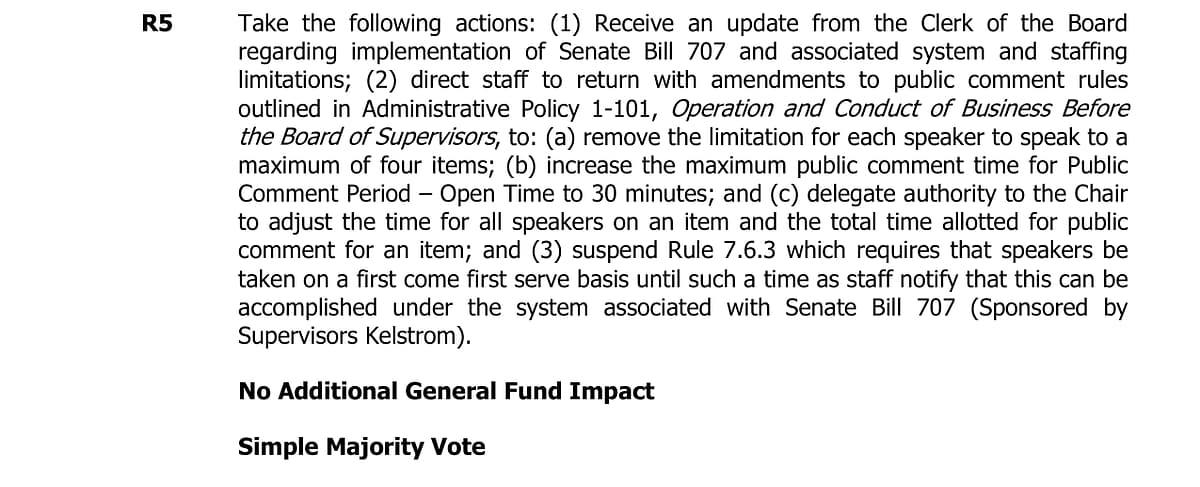
Supervisor Chris Kelstrom sponsors a three-part item responding to Senate Bill 707, the 2025 amendment to the Ralph M. Brown Act whose major mandates take effect July 1. The board would receive a clerk's update on SB 707 compliance and the county's system and staffing limits; direct staff to amend Administrative Policy 1-101 to remove the four-item cap on speaker topics, raise the general "Open Time" public-comment period to 30 minutes, and delegate timing decisions to the chair; and suspend Rule 7.6.3, the first-come, first-served speaker order, until the county's system can support it. The item carries no General Fund cost and needs a simple majority.
SB 707, by Sen. María Elena Durazo, is Chapter 327 of the Statutes of 2025, signed Oct. 3, 2025. Its disability-accommodation teleconferencing provisions took effect Jan. 1, 2026; the heavier mandates for an "eligible legislative body" — a category Shasta's board falls into as a county of more than 30,000 residents — become operative July 1. Those mandates require two-way telephonic and audiovisual remote participation, a live webcast, agenda translation and language-equity outreach, the practical reason a pure in-person speaker queue must give way. The changes also answer a long-running local fight: the North State Breakdown reported Feb. 10 on a Brown Act challenge to the board's public-comment handling, and the chamber has repeatedly seen disputes over speaker counts and personal attacks on Kelstrom, who has managed the disruptions from the dais.
BOARD INTRODUCES EMINENT-DOMAIN CHARTER LIMIT FOR NOV. 3 BALLOT (R6)
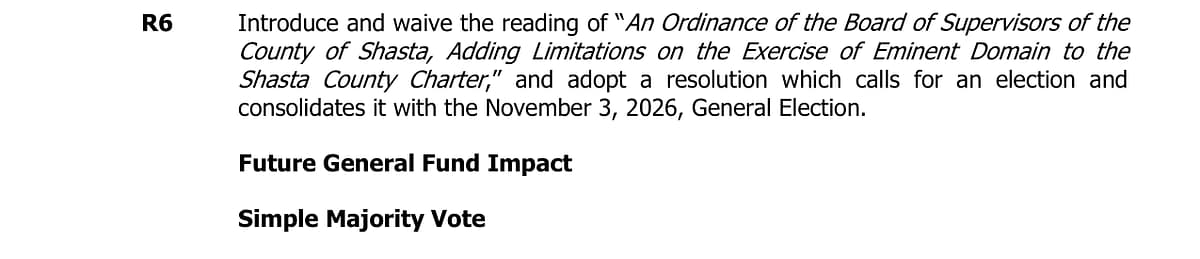
The board introduces an ordinance, "Adding Limitations on the Exercise of Eminent Domain to the Shasta County Charter," and a companion resolution calling for its placement on the Nov. 3, 2026 ballot. The measure needs a simple majority to advance. It is the formal next step after June 16, when the board voted 3-2 to bring the measure back and send it to voters.
The ordinance is a general, anti-Kelo provision: it bars the county from exercising eminent domain "to acquire property from any private owner … when the purpose of the acquisition is to convey the property so acquired to any private party." It does not single out any industry or project. Supervisor Long, who voted against bringing it back, confirmed the narrow reading on the record June 16, noting the measure addresses private-to-private takings and "does not talk about private property being taken to give to public good." Crye, who moved to advance it with Plummer's second, called it "a layer of protection forever for 50 grand" and said he was "trying to return it to the public and protect it."
The measure revives Measure P, which Shasta County voters rejected on Nov. 5, 2024, by roughly 350 votes out of about 80,000 cast, according to Ballotpedia. The central objections were that placing a measure costs the county about $50,000 while a stand-alone special election can run to roughly $1 million, and that eminent-domain power is already tightly constrained by state law and the California Constitution, making a county-charter limit largely symbolic — binding only the county's own condemnation power, not Caltrans, water districts or the state. Supervisor Long has been the chief fiscal opponent of both ballot measures.
BOARD INTRODUCES ELECTED-VACANCY CHARTER MEASURE FOR NOV. 3 BALLOT (R7)
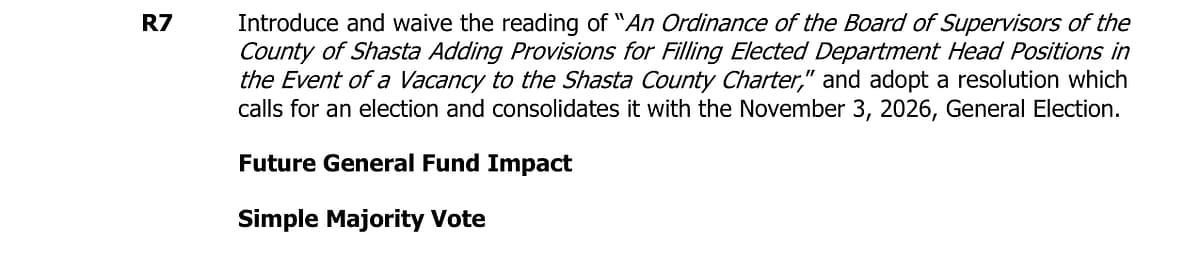
The board takes the parallel step on a second charter amendment, introducing an ordinance "Adding Provisions for Filling Elected Department Head Positions in the Event of a Vacancy" and a resolution placing it on the same Nov. 3 ballot. It needs a simple majority. On June 16 the board voted 4-1, with amendments, to bring the measure back.
The amendment covers the county's elected department heads — the Assessor-Recorder, County Clerk and Registrar of Voters, Sheriff-Coroner, Auditor-Controller, District Attorney and Treasurer-Tax Collector. As amended by Crye on June 16, it would require the board, on a vacancy, to fill the seat by an election consolidated with the next regular election if one falls within 12 months; otherwise the board could appoint by open recruitment, but only on a four-fifths vote, with the appointee serving the remainder of the term. County Counsel cautioned that the affected offices carry different replacement rules under state law and that the single measure conflates them. Plummer framed his support around a preference for elections — "unless we can't without incurring significant costs, let's have it default to an election" — while Long objected that a one-item special election "could be a million dollars" and "this county cannot afford that."
The measure is inseparable from the county's two-year fight over the Registrar of Voters office, which passed from Cathy Darling Allen — who retired in May 2024 — through appointed successors Tom Toller and Clint Curtis to Joanna Francescut, who defeated Curtis in the June 2 primary (Curtis still hasn't conceded, and state he would not until the vote was certified, something that he has to put forward to the board). Public commenters on June 16 tied the measure directly to the board's repeated refusal to appoint Francescut, one telling supervisors, "Two times this room was filled with citizens urging you to appoint Joanna, and this board did not listen," and another noting "58% of the voters voted Measure Q down" — a reference to the elected-vacancy measure rejected in 2024. Both R6 and R7 trace back to the county's October 2023 charter process; the cost mechanics and Nov. 3 ballot timing apply identically to each.
BOARD ADOPTS $658 MILLION FY 2026-27 BUDGET (R8)
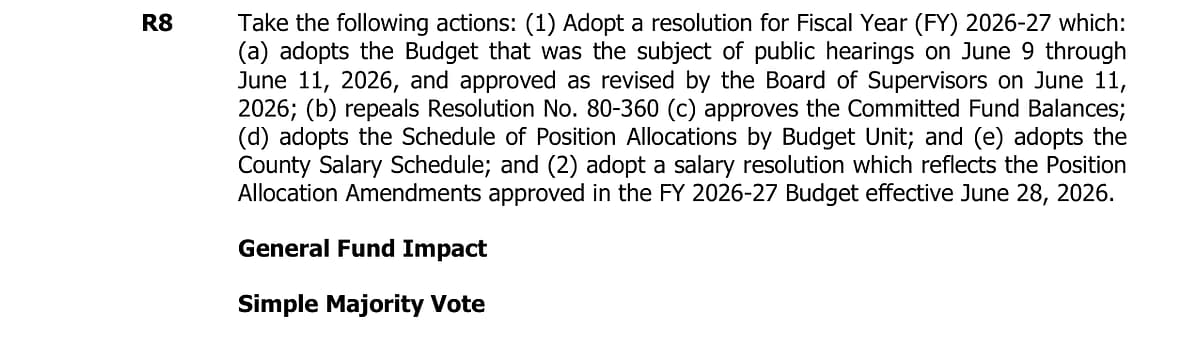
The board adopts the fiscal 2026-27 budget approved as revised at the close of its June 9-11 hearings. The adopting actions repeal Resolution 80-360, approve committed fund balances, and adopt the position-allocation list and salary schedule, with the salary resolution effective June 28. The item, brought by Erin Bertain, affects the General Fund and needs a simple majority. Staff also noted a technical correction in the Statham-Robbins Criminal Construction administration unit, adding $35,000 in transfers out to the DA and $11,630 to the Public Defender.
The proposed budget totals about $658 million, a $27 million decrease and roughly a 3 percent General Fund reduction. Reserves stand at 14.8 percent, below the county's 17-to-25 percent policy target, and the county carries a $322 million unfunded pension liability. Rising costs ran through the hearings: general-liability premiums climbed from $7.3 million to $9.5 million and malpractice coverage from $650,000 to $1 million, which Support Services Director Monica Fugit attributed to "increasingly litigious" personnel matters. Public Defender Ashley Jones told the board June 11 that "if our department was a medical patient … we're in the ER and we're actively bleeding out." Among the contested calls, the board approved $10,000 retention bonuses for attorneys in the DA, Public Defender and County Counsel offices on a 5-0 vote. The adopting resolution also affirms that the budget, as adopted, falls within the county's state-mandated appropriations (Gann) limit.
CLOSED SESSION: EMPLOYEE APPEAL LITIGATION (R9)
The board recesses to closed session for one item of existing litigation under Government Code Section 54956.9(d)(1) — an employee appeal involving UPEC Local 792 — estimated to take about 10 minutes. The matter is of a piece with the labor and personnel-cost pressures threaded through the budget, where rising liability and malpractice premiums were tied to an "increasingly litigious" personnel environment.
OTHER AGENCIES
As is routine, the supervisors will recess and reconvene as the governing boards of several affiliated agencies — the Housing Authority, the In-Home Supportive Services Public Authority, and the Shasta County Water Agency — to handle each body's business.
And that's the agenda preview.