

Crye brings back failed charter measures, advances disputed nonprofit cap, Board discusses Measure B Lawsuit
 By Benjamin Nowain•June 16, 2026•9 min read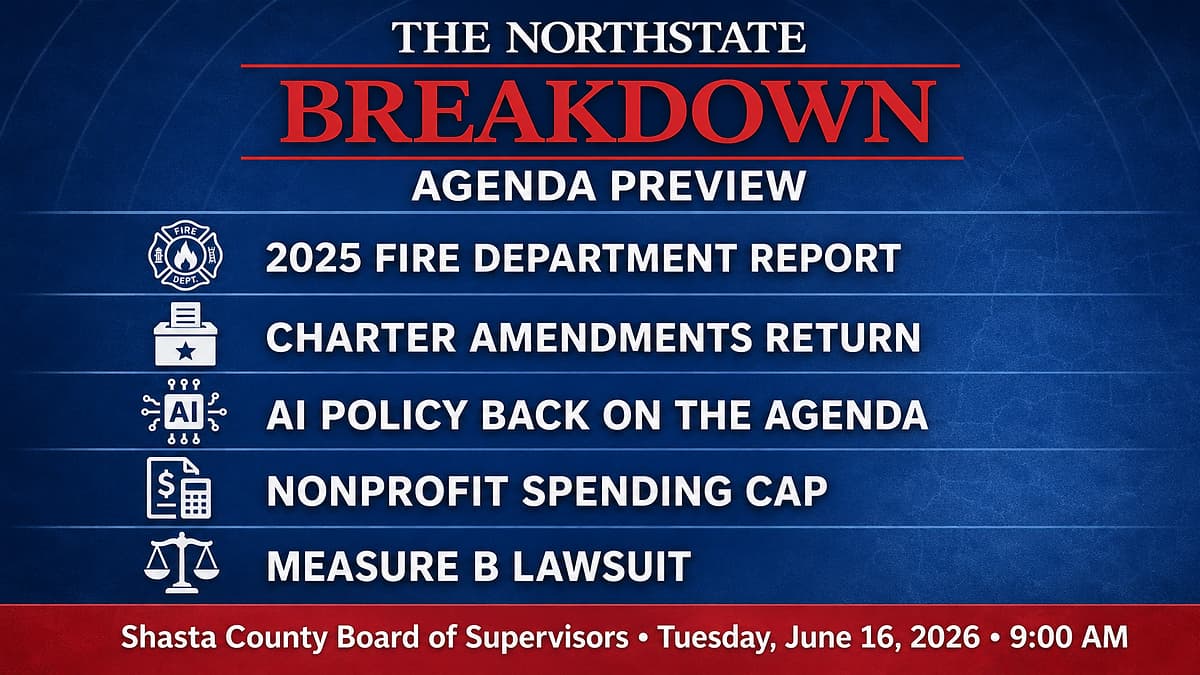
REDDING, Calif. — The Shasta County Board of Supervisors convenes Tuesday at 9 a.m. with an agenda that keeps circling back to a single question: what this board does when its signature projects run into state law, the county's own finance staff, or the voters themselves. In one morning, supervisors will weigh reviving two charter amendments the electorate rejected in 2024, advance a nonprofit spending cap that the county's own auditor and county counsel decline to endorse, and retreat into closed session over the state's lawsuit to undo Measure B — the voter-ID measure county residents approved just two weeks ago.
The meeting also arrives in a moment of transition. Returns from the June 2 primary show District 1 Supervisor Kevin Crye — the sponsor of Tuesday's charter item — losing to challenger Erin Resner, and board Chair Chris Kelstrom of District 5 heading toward November runoff. Several of the day's most consequential items are being pushed by supervisors whose standing on the board may be about to change.
What follows is a guide to what is on the table, and what is worth watching.
R1 & R2 — CSAC comes to Redding
The morning opens with Graham Knaus, chief executive of the California State Association of Counties, presenting on CSAC's current work on the county's behalf, followed by certificates for county employees who completed CSAC Institute leadership courses held from January through May. The staff report lists ten courses covering leadership strategy, emotional intelligence, burnout and conflict resolution. There is no county cost beyond what departments already budgeted, and no vote. It is the lightest business of the day — a leadership-development recognition on a morning otherwise defined by institutional friction.
R3 — 2025 Fire Department Annual Report, as the thermometer climbs
County Fire Chief Sean O'Hara will present the department's 2025 annual report, and the board will vote on a resolution certifying that the department completed the 370 fire safety inspections it is required to report under state law. The certification is the actionable piece; the report itself is where the substance lies.
The numbers describe a department doing more with a thinner bench. Shasta County Fire responded to 15,434 incidents in 2025, up 3.7% from the year before. The department has formally retired the term 'volunteer firefighter' in favor of 'paid call firefighter,' a change the report ties to declining participation as longtime members retire — and it singles out eroding water-tender capability as a specific casualty of that attrition. To compensate, the department says it is raising career staffing across stations, and it added four new Type VI engines and a breathing-support unit in 2025.
The report is candid about money. Among its 2026 priorities is the development of a long-term funding strategy, with the department warning that rising call volumes, longer incidents and growing wildfire risk 'can no longer be supported by traditional funding structures.' On the prevention side, it logs 11,923 acres treated for fuel reduction and the 2025 adoption of defensible-space standards under a new county ordinance.
Context: the report reaches the board as the region enters fire season under stress. The Redding Record Searchlight reported June 12 that temperatures were forecast to hold above 100 degrees into the following week, with a National Weather Service heat advisory in effect. Worth watching for whether any supervisor connects the department's stated funding gap to the budget pressures visible elsewhere on the county's books.
R4 & R5 — Housekeeping
Two items move quickly. In R4, the county executive officer delivers a routine update on county issues and the legislative platform, and supervisors give their reports; the packet flags no specific legislation. In R5, the board is asked for retroactive approval to use retained earnings from the 2024-25 fiscal year — $41,691 in the Fall River Mills Airport Administration Fund and $197,725 in the Facilities Management Administration Fund. It is year-end accounting cleanup, but it carries a 4/5 vote threshold.
R6 — The charter amendments, round two
Sponsored by Crye, the board will discuss bringing back two amendments to the county charter — one limiting the county's use of eminent domain, the other setting how vacancies in elected offices are filled — and direct staff to return June 23 with ordinances that would place the measures before voters in November. The amendments would take effect only if the electorate approves them.
Voters have seen these before. After Shasta became California's 15th charter county with the March 2024 passage of Measure D, the same two amendments went to the ballot that November as separate measures, and both failed. Measure P, on eminent domain, drew 49.78%. Measure Q, on filling vacancies, drew 41.48%. The staff report estimates that each countywide ballot measure reduces the county's election revenue by $20,000 to $50,000, a cost borne by the General Fund.
The 2024 effort also produced a procedural episode worth recalling. According to meeting records, the board in August 2024 temporarily suspended its own rule limiting how supervisors may formally weigh in on ballot measures — Administrative Policy 1-101 — so the board majority could author the official argument in favor of Measure P, with then-Chair Crye designated to write it. The maneuver was legal and done in open session, but it placed the measure's chief proponents and its official ballot advocates on the same side of the dais.
Worth watching: whether the board commits General Fund money to send voters measures nearly identical to ones they rejected 18 months ago, and whether the sponsor's contested re-election factors into the timing.
R7 — An AI resolution, with no path forward yet
Supervisors will take a second run at a resolution committing the county to the 'responsible and strategic use of artificial intelligence' in county government, with safeguards for privacy, data security and human oversight. Brought by District 4 Supervisor Matt Plummer, who has said he wants Shasta to be 'the most AI-literate community in California,' the resolution is a statement of intent rather than binding policy. It states that AI would be used to 'augment, not replace' county staff and that final accountability stays with county officials.
The board discussed the resolution June 8 but held off, citing a need to bring the county's information officer into the conversation.
Context: the county has no formal AI policy on the books, even as California courts and state agencies move faster on the question — most California courts have adopted generative-AI use rules, and the state recently disclosed using high-risk AI systems it had not previously reported. Worth watching for whether the board treats this as a genuine governance framework or a symbolic endorsement that leaves the hard rules for later.
R8 — A nonprofit cost cap the county's own auditor won't endorse
The board will introduce an ordinance requiring any nonprofit that wants county funding or support to keep its administrative costs at or below 18% of total revenue. The cap would reach grants, contracts, appropriations and in-kind support, and it defines administrative costs broadly — executive salaries, rent, utilities, accounting and legal fees, insurance, and fundraising. Nonprofits would have to document compliance with audited financials or a Form 990 and a signed certification from their executive director and board chair. Applications that miss the threshold would be denied; exceptions would require a majority board vote.
The proposal has moved fast and grown stricter. The staff report says the board first directed staff on May 19 to draft a cap at 10% of revenue, then raised it to 18% on June 8. What it has not picked up along the way is the sign-off of the county's own fiscal and legal officers. In the staff report's own words: 'The Auditor-Controller does not approve of the ordinance. County Counsel does not approve the ordinance as to form.'
Auditor-Controller Nolda Short made her objection explicit in a letter attached to the agenda. She wrote that she supports controlling administrative costs but warned that a blanket 18% cap 'could create situations in which federal requirements conflict with local ordinance provisions.'
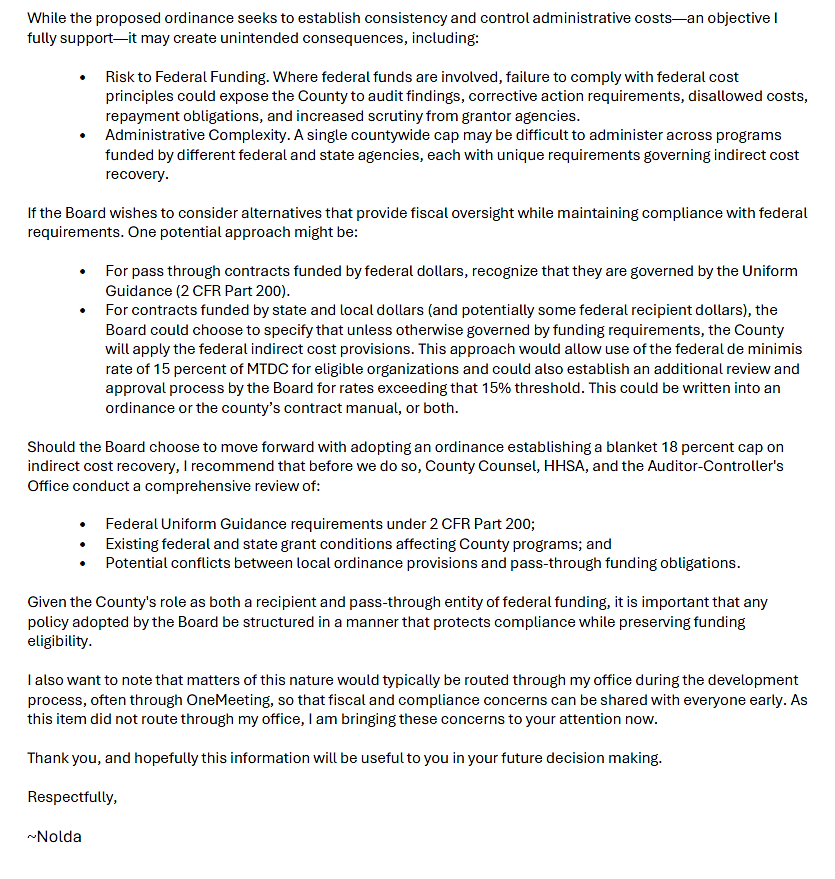
Many county-funded nonprofits, she noted, deliver federally funded programs governed by the Uniform Guidance (2 CFR Part 200), under which the county must generally honor a nonprofit's federally negotiated indirect cost rate or its election of the federal de minimis rate of 15% of modified total direct costs. A countywide cap, she cautioned, could expose the county to audit findings, disallowed costs and repayment obligations. She also flagged a process problem: the item, she wrote, 'did not route through my office.'
The dispute touches a long-running debate in the nonprofit world. Watchdogs including Charity Navigator and the BBB Wise Giving Alliance have for more than a decade warned against the 'overhead myth' — the idea that a low administrative-cost ratio signals an effective charity. Researchers have documented a 'nonprofit starvation cycle,' in which pressure to report low overhead drives organizations to underfund the staff, technology and oversight that make programs work. And the federal benchmark the auditor cites cuts against the ordinance in a specific way: the 15% de minimis rate is a floor available without justification, not a ceiling, which means a hard local cap can be more restrictive than the federal rules it sits alongside.
Worth watching: whether the board introduces an ordinance two of its own officers have formally declined to endorse, and whether anyone on the dais reconciles an 18% cap with the federal cost rules the auditor says it may violate.
R9 — Closed session, and the Measure B reckoning
The board will recess into closed session, an estimated 20 minutes, to confer with legal counsel on three existing lawsuits. Two are labor matters — Howard Wilson and John Bergen, both before the State Mediation and Conciliation Service — with little in the public record. The third is the one drawing the attention.
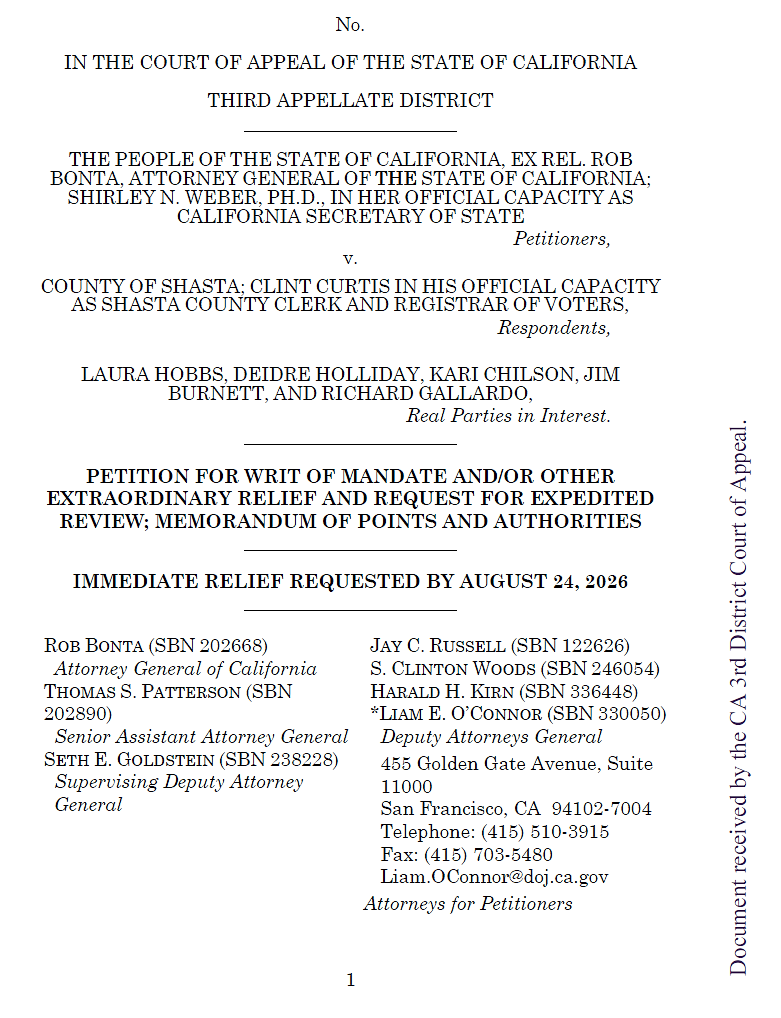
Attorney General Rob Bonta and Secretary of State Shirley Weber initiated a lawsuit on June 12 in the Third District Court of Appeal seeking to strike down Measure B, the voter-ID measure Shasta County voters approved June 2 with about 55% support. Measure B would require photo identification to register and vote in person, eliminate most mail and early voting, mandate hand-counting of ballots, and set up a county voter-registration system disconnected from the state's database. The state filed directly in the appellate court as an original writ petition, asking the court to bar the measure's implementation. According to the attorney general's office, the suit argues that Measure B exceeds the county's authority even as a charter county and is preempted by state law, including a 2024 statute that bars local voter-ID requirements at the polls. The filing names the measure's five proponents — Laura Hobbs, Deidre Holliday, Kari Chilson, Jim Burnett and Richard Gallardo — along with the Registrar of Voters. No court has ruled on the measure's validity; the state's claims are allegations.
\
The state is not arguing in a vacuum. It points to its successful challenge of a similar voter-ID measure in Huntington Beach: after that city's voters approved a charter amendment in 2024 and the Legislature passed a law barring local voter-ID rules, a state appeals court struck the measure down in November 2025, and the California Supreme Court declined to review the decision in January 2026. The state cites that outcome as precedent for the voter-ID portion of Measure B.
That leaves the board with a politically loaded choice it has faced before: whether to defend Measure B at all. It has already signaled its posture once, voting not to defend an earlier challenge to the measure, with Crye the only supervisor in favor of mounting a defense; the conservative majority also declined a request to cover the proponents' legal fees. The calculus is especially delicate for Kelstrom, the board chair now facing a likely November runoff, who argued against the measure's approach long before the state sued.
In a March 17, 2025 debate with proponent Richard Gallardo on the program Patriot State of Mind, Kelstrom made the case that the county simply could not do what Measure B attempts:
"The board does not have the jurisdiction to change election laws. The board does not have the jurisdiction to put something into the charter that says, hey, we can ignore all federal laws, we can ignore all state laws, and we can do what we want. We don't have that ability."
He went further, predicting almost exactly the situation the county now faces — pointing to Huntington Beach as the cautionary tale:
"Huntington Beach wrote a charter amendment and they got sued before it even got on the ballot ... as soon as they ask for somebody for an ID, they're going to be sued again by California and they're going to lose. And not only that, but California wrote a law immediately when they lost the lawsuit that said no other charter counties or cities can add this to their charter."
Fifteen months later, the state has sued, the measure has passed, and the question Kelstrom debated then now sits on the board's closed-session agenda.
Why this meeting matters
Read together, Tuesday's agenda is a portrait of a board testing limits. It is being asked to spend General Fund money to send voters charter measures they already rejected, to adopt a nonprofit spending rule its own auditor and lawyer will not endorse, and to decide whether to defend an election law that its chair once argued was bound to lose in court — all while the voters who may have just reshaped the board wait for their ballots to be certified. Each item can be defended on its own terms. The thread connecting them is a board repeatedly choosing the harder collision over the easier retreat. Whether any supervisor names that pattern in open session is, as ever, worth watching.